Overview
New report reveals anxiety and financial risk reshaping students’ post‑school choices.
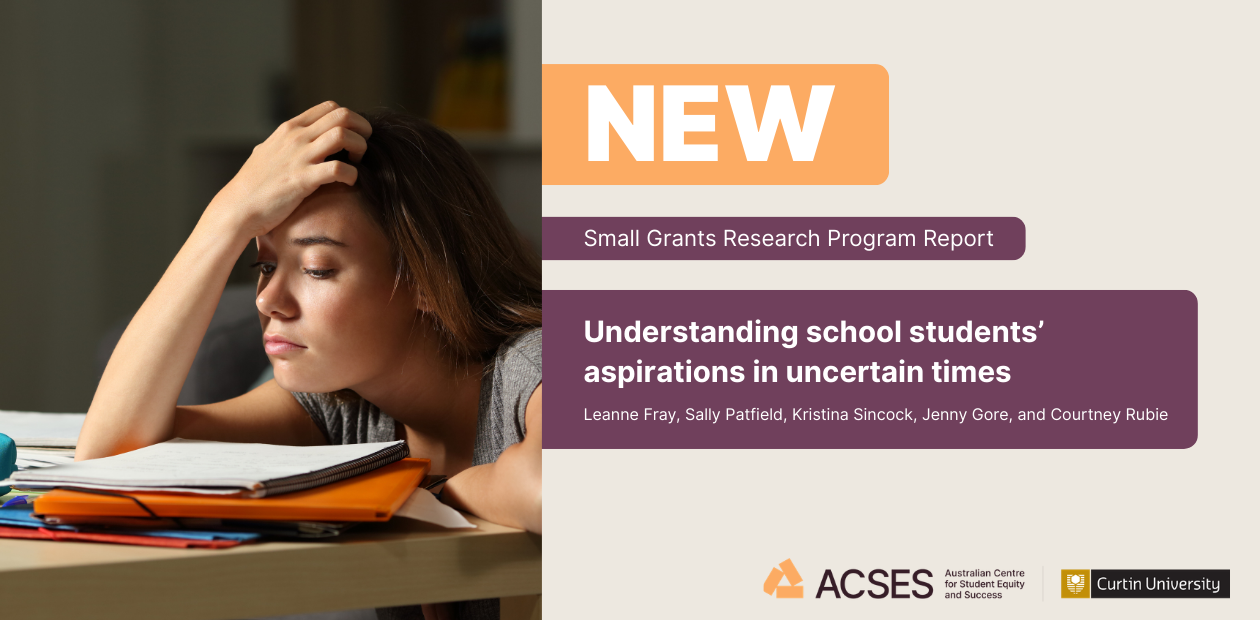
The Australian Centre for Student Equity and Success (ACSES) has published a new report through its Small Grants Research Program:
Understanding school students’ aspirations in uncertain times by Leanne Fray (The University of Newcastle), Sally Patfield (The University of Newcastle), Kristina Sincock (The University of Newcastle), Jenny Gore (The University of Newcastle), and Courtney Rubie (The University of Newcastle).
The report outlines how a growing uncertainty of post-school futures particularly amplifies equity gaps, calling for an increase in support for rural, regional, and low socio-economic status areas and greater focus on student well-being.
Recommendations from the report include:
Government
- Invest in public schools, particularly in rural, regional, and low socio-economic areas, to address residualisation and ensure equitable access.
- Reform higher education and vocational education funding to improve affordability, including fee-free TAFE, scholarships, and income support for equity groups.
- Improve regional infrastructure, including transport, housing, and digital connectivity, to reduce relocation pressures for students.
- Elevate the status of vocational education through policies that recognise its social value and support diverse career pathways.
- Guarantee free, bulk billed access to youth mental health services to address rising levels of anxiety and depression.
- Subsidise affordable student housing for those who must relocate to pursue further education.
Universities
- Expand flexible access options, including regional campuses, study hubs, blended learning, and bridging programs.
- Prioritise student wellbeing and belonging through culturally safe spaces, mentoring, and inclusive teaching practices.
- Co-design outreach and recruitment initiatives with communities to reflect local needs and values.
Schools
- Embed mental health and wellbeing supports in everyday school practice, not as add-ons.
- Strengthen career education through early, culturally responsive, and community-connected programs.
- Promote vocational and hybrid pathways by showcasing diverse alumni success stories and challenging the academic-vocational divide.