Overview
New report highlights strategies to strengthen pathway programs for Indigenous student success.
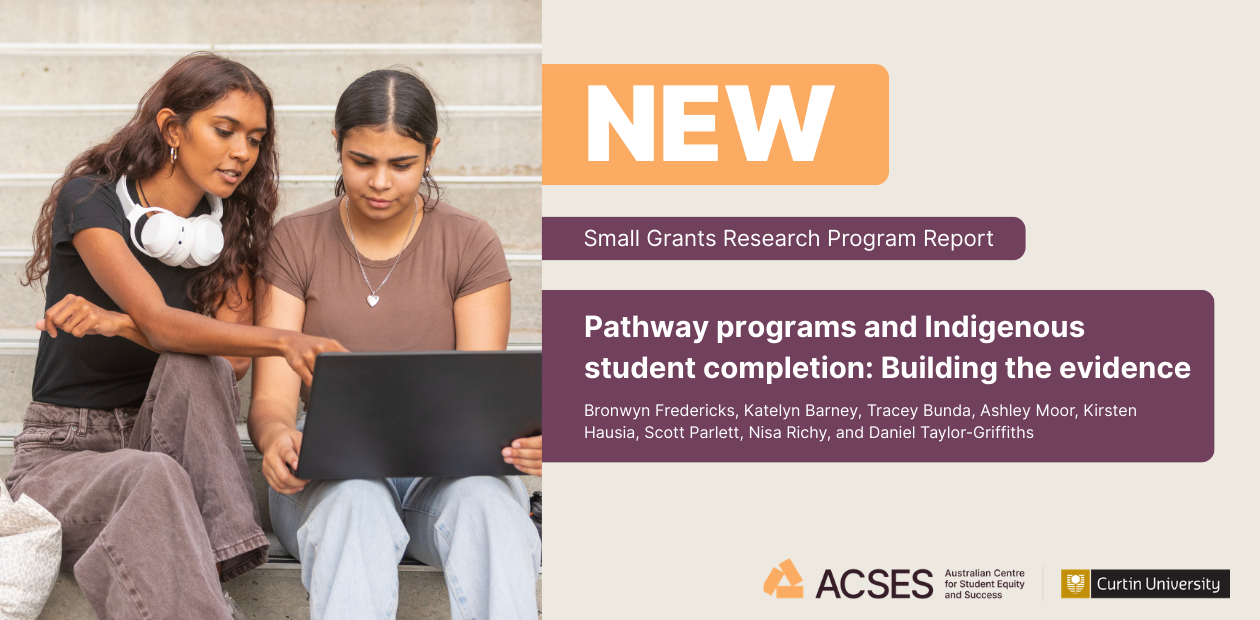
The Australian Centre for Student Equity and Success (ACSES) has published a new report through its Small Grants Research Program:
Pathway programs and Indigenous student completion: Building the evidence by Bronwyn Fredericks (The University of Queensland), Katelyn Barney (The University of Queensland), Tracey Bunda (The University of Queensland), Ashley Moor (UQ College), Kirsten Hausia (The University of Melbourne), Scott Parlett (University of New South Wales), Nisa Richy (The University of Queensland), and Daniel Taylor-Griffiths (The University of Queensland).
The report outlines how pathway and enabling programs are central to preparing and transitioning Aboriginal and Torres Strait Islander students into university and how improvements such as peer-to-peer connections, Indigenous centres, and more Indigenous perspectives can increase success for Indigenous students in their university life.
Recommendations from the report include:
Key stakeholders
- Pathway program leadership need to ensure cultural competency training opportunities for teachers and support staff in pathway programs.
- Pathway program teaching staff should work collaboratively with Indigenous academics and community members to ensure Indigenous perspectives are strongly embedded in course curricula.
- Pathway program leadership and Indigenous centre/unit staff should work together to ensure strong supports are in place for Indigenous students.
- Pathway program teachers/support staff and Indigenous centre/unit staff should continue to develop and strengthen strategies that build a sense of belonging and connection for Indigenous pathway program students to the university. For example, student-led events, creative workshops, or co-design sessions with students.
- Pathway program leadership should ensure there are initiatives in place to provide mentoring opportunities for Indigenous students in pathway programs (for example, with graduates or university students who previously participated in a pathway program).
- Pathway program leadership should work with university IT services and the Indigenous centre/unit to develop better data gathering so that student pathways can be tracked and timely support provided to Indigenous students. This could then assist with setting up mentoring opportunities between past and present Indigenous pathway program students.
Government
- The Australian Government Department of Education could pilot amendments to data collection practices to facilitate more granular analysis of the student lifecycle from application to completion potentially using Unique Student Identifiers (USIs).
- The Australian Government Department of Education could pilot including a separate analysis of the national Indigenous student population in the annual cohort analysis of higher education students.
Read the research highlights and the full report here.