Overview
New report calls for the prioritisation of improving online pedagogies and fostering interactive and socially engaging virtual environments.
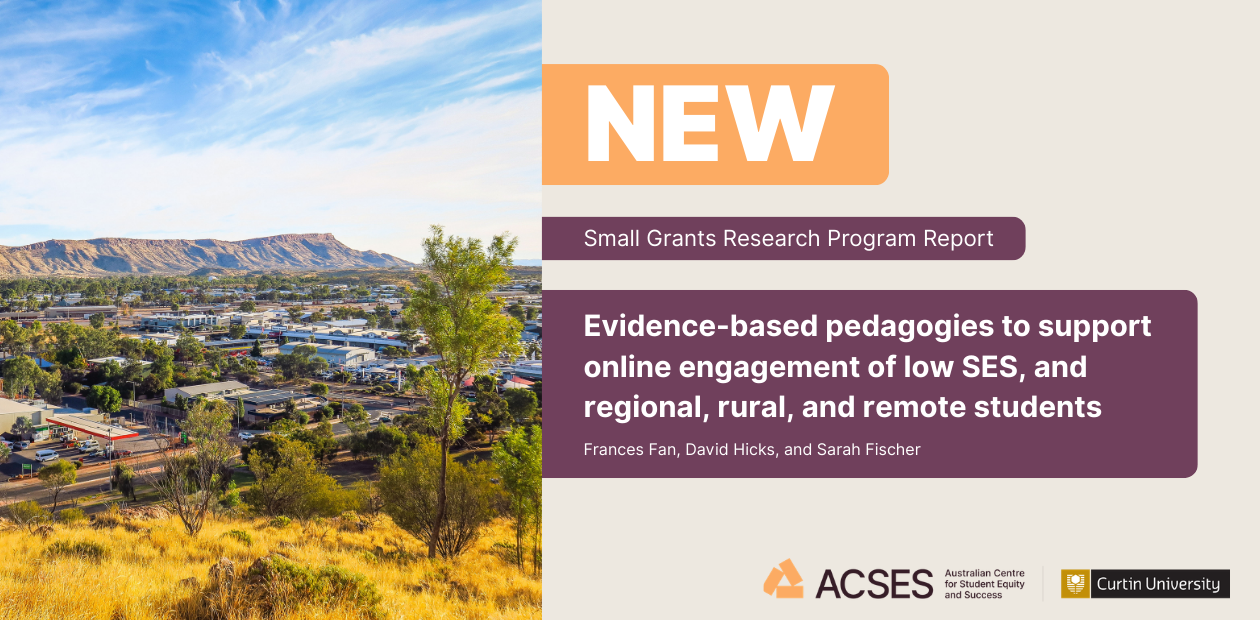
The Australian Centre for Student Equity and Success (ACSES) has published a new report through its Small Grants Research Program:
Evidence-based pedagogies to support online engagement of low SES, and regional, rural, and remote students by Frances Fan, David Hicks, and Sarah Fischer from the University of Tasmania
The report outlines how a lack of pedagogical support for students studying online disproportionately impacts on students from disadvantaged backgrounds, including lower course completion rates and a reduced sense of place and belonging.
Recommendations from the report include:
For teachers of online and blended subjects
- Teachers should learn about the characteristics and needs of their learner cohorts and continuously inform their pedagogy by reflecting on what student say they need.
- Teachers should embed links between the formal curriculum and co-curricula support and resources in subject level design to help students understand what help is available for their studies.
- Teachers in large online subjects, or blended subjects that have a significant online component, should use Universal Design of Learning (UDL) principles to cater for the needs of their diverse learner cohorts.
- This report provides a toolkit with a range of tools that can be used to foster student engagement, teachers in online and blended subjects should select the tools suitable for their learner cohorts.
- To foster social integration, teachers should aim to create a sense of belonging and a sense of (virtual) place through online community building.
- Teachers should aim to reduce cognitive load for students through the design and layout of their online teaching spaces.
- Teachers should be familiar with institutional level support and how to assist students to access them.
For university leaderships and policy makers
- As access expands and cohorts become more diverse, institutions should align support and resources to match the needs of the cohort and staff supporting them.
- Learning support services requested by equity students for successful progression should inform the design of a co-curricular support framework that supports each key stage of their degree in order to help them to move on to the next stage of their university course.
- When using LMS data, Institutions should interpret the data in light of the academic context and be aware of the varied quality and reliability of the data available.
- Institutions should seek higher accessibility and presentation of learning and teaching data accessible and presentation, allowing leaderships at different levels, and teachers in individual subjects, to understand their student cohorts.
- Institutions should have more preventative approaches in supporting equity students and identifying at-risk students.
- Institutions should explore ways to understand and track students’ social presence / engagement in online learning.
- Universities should prioritise improving online pedagogies and fostering interactive and socially engaging virtual environments and how student from various equity groups respond to these.