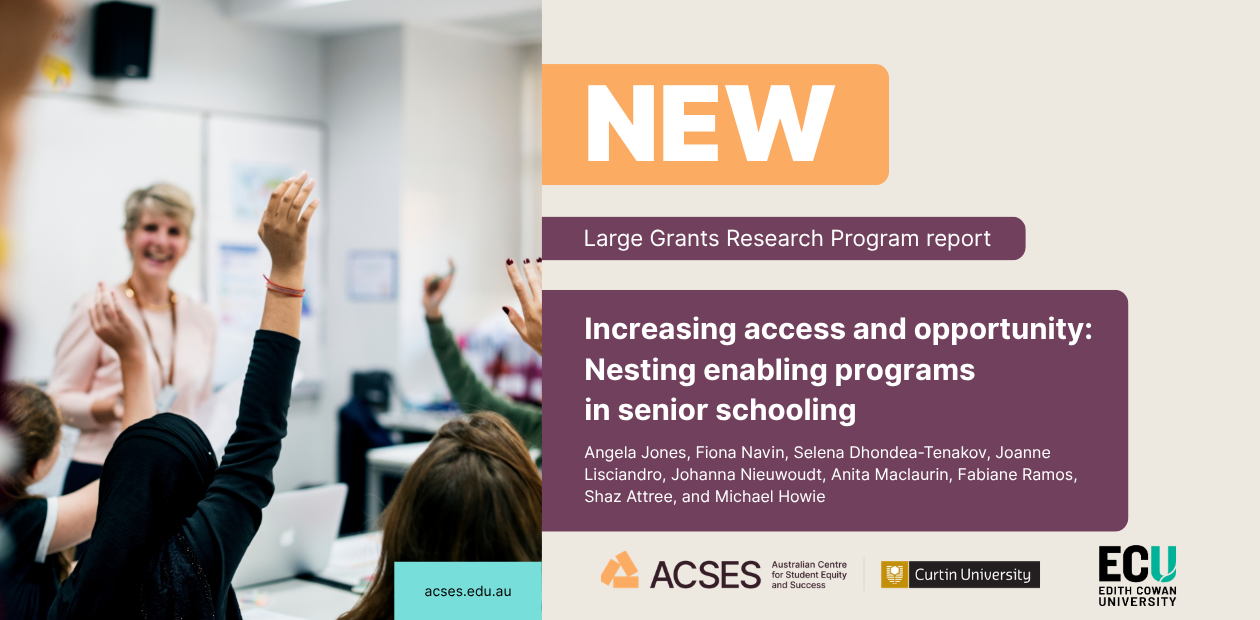
A new Australian Centre for Student Equity and Success (ACSES) research report reveals compelling evidence for the effectiveness of in-school enabling programs (ISEPs), providing new and supported pathways into higher education.
Universities and schools deliver ISEPs in partnership to provide direct pathways to higher education for students—often from disadvantaged or equity backgrounds—who lack access to, or do not thrive in, ATAR-focussed pathways.
The report looked at almost 2000 students from 94 high schools across Australia who enrolled in ISEPs from 2021-2023 and found 79% went on to complete their university pathway program.
Lead investigator Dr Angela Jones of Edith Cowan University said ISEPs equip high school students with the skills and confidence to succeed at university, particularly for those who may face barriers to higher education.
“We knew universities and schools were building supportive, academically rigorous programs—this research reveals they are more than that,” Dr Jones said.
“Our study shows ISEPs are academically robust, transformative pathways that build students’ self-belief so they can not only access university, but have a healthy wellbeing and sense of belonging once there.”
Funded through ACSES’s Large Grants Research Program and including researchers from Murdoch University, Southern Cross University, and the University of Southern Queensland, the project is the first national study to compare ISEPs across institutions, examining how they work and the outcomes they achieve—particularly for students from underrepresented backgrounds.
ACSES Research and Policy Program Director Professor Ian Li said the data confirmed ISEPs attract high numbers of students who are underrepresented at university, help break down barriers and deliver strong pass and completion rates.
“Students and educators highlighted the powerful personal impact of these programs, including greater confidence, resilience, and a stronger sense of belonging, alongside the development of essential academic skills,” Professor Li said.
Other key findings include:
- ISEPS typically have higher success and completion rates than post-school enabling programs.
- Once at university, students from equity cohorts entering via ISEPs are retained at near parity with their peers, indicating ISEPs help narrow retention gaps that remain pronounced in ATAR pathways.
- ISEPs build self-efficacy, with results on measures of resilience, wellbeing, and belonging comparable across students from equity cohorts and their peers.
The report’s recommendations include securing more sustainable funding for ISEPs, establishing a nationally endorsed enabling education framework, and implementing targeted strategies to address systemic barriers impacting equity students.
For more, read the full report here: Increasing access and opportunity: Nesting enabling programs in senior schooling.
Media Contacts:
Anna Will, ACSES Communications and Stakeholder Engagement Manager
Tel: (08) 9266 3948 Mobile: 0478 373 246 Email: anna.will@curtin.edu.au
Sam Jeremic, Corporate Communications Specialist, Curtin University
Tel: (08) 9266 3529 Mobile: 0407 601 993 Email: s.jeremic@curtin.edu.au
Esmarie Iannucci, Media and Communications Manager, Edith Cowan University
Mobile: 0405 774 465 Email: e.iannucci@ecu.edu.au