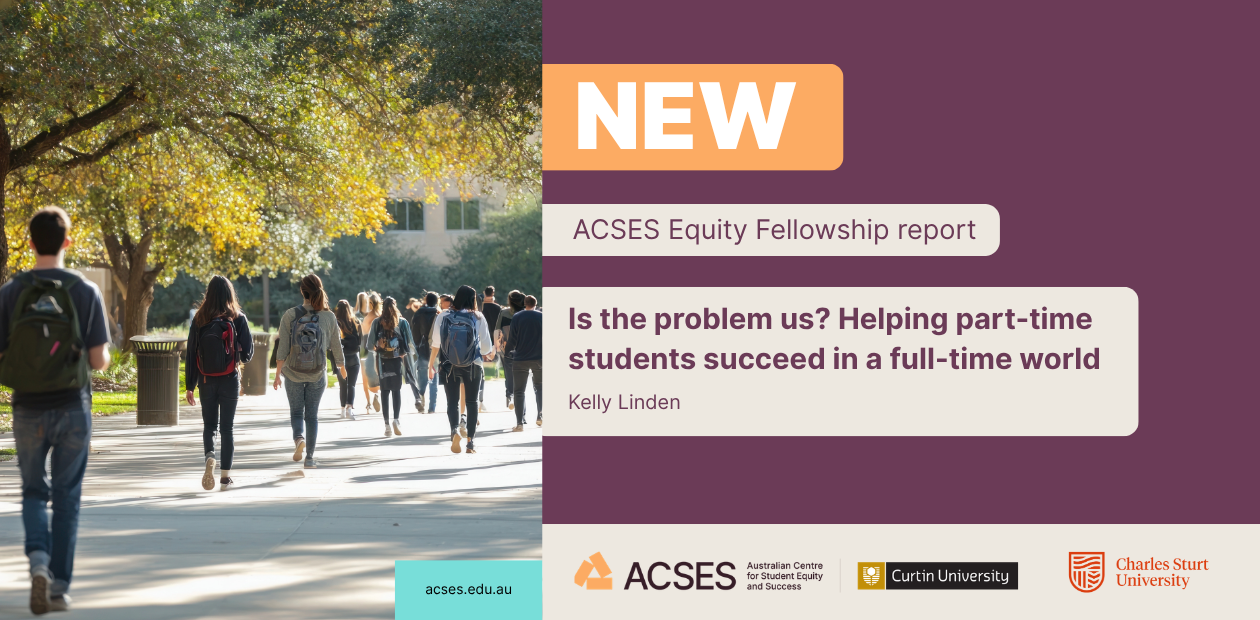
Expanded access to Government financial support, additional public transport subsidies, and more flexible assessment deadlines are among 12 recommendations in a new report from the Australian Centre for Student Equity and Succes (ACSES) on the challenges facing part-time students.
Based on interviews with nearly 1,000 students from diverse backgrounds at 35 Australian universities, the report highlights the extent to which part-time students are juggling competing responsibilities, such as caring and work commitments.
It calls for special consideration policies including listing work and caring commitments as acceptable reasons for an assignment extension.
Other recommendations for universities and governments include Federally funded Youth Allowance, Austudy, and Tertiary Access Payments for part-time students and tax exemptions for scholarships and PhD stipends.
Study author Associate Professor Kelly Linden, of Charles Sturt University, said the research showed part-time students needed more flexibility and support to succeed.
“The participants demonstrated that, although they are incredibly dedicated to their studies, university cannot always be their number one priority,” she said.
“With part-time students making up 35 per cent of all domestic Australian university students, it’s time to start designing our universities for this growing cohort which is no longer a small minority on our campuses.”
The report also calls for student load policies to be simplified so anyone studying 75 per cent of the Equivalent Full-Time Student Load (EFTSL) across a calendar year has the same benefits as a full-time student.
Associate Professor Linden said the report also highlighted the need for increased support for full-time students.
“All students should have access to no-questions-asked extensions,” she said.
“States provide free public transport to the football, yet part-time, on-campus students pay full fare to travel to university, and this is inequitable.
“State Governments should provide discounted public transport for all students studying on-campus.”
ACSES Research and Policy Program Director Professor Ian Li said the report was a timely reminder of the increasingly complex demands facing part-time students.
“This research shows part-time students on average have lower rates of success and retention than full-time students and are more likely to belong to an equity group,” he said.
“It highlights the need for universities and State and Federal Governments to review their policies to ensure all students have adequate time to access high-quality learning and teaching.”
ACSES RECOMMENDATIONS
Universities to:
- ensure academic workloads allow time to build relationships with students, create high-quality consistently designed units, release material early, record all classes, and provide opportunities for peer connection
- treat students studying 0.75 EFTSL or more as full-time, regardless of how their study is spread across the year
- make work-integrated learning placements more flexible, including offering part-time placements and recognising relevant industry experience
- reduce unnecessary compulsory attendance and provide clear information about mandatory classes and timetables before enrolment
- expand access to no-questions-asked assessment extensions, revise special consideration policies to include work and caring responsibilities, and allow automatic extensions through disability access plans
- improve access to scholarships for part-time students facing financial hardship
- promote student success rather than failure, including allowing resubmissions for near-pass (“near miss”) assessments
- provide clearer advice on part-time study patterns and review maximum time-to-complete policies to ensure they are fair for part-time students
- develop reciprocal study-space agreements between universities so students can access campus facilities closer to where they live.
State Governments to:
- provide public transport concessions to all on-campus students, based on attendance mode rather than full-time or part-time study load.
Federal Government to:
- make scholarships and PhD stipends tax-free for part-time students
- extend financial support to part-time students, including eligibility for Youth Allowance, Austudy, and Tertiary Access Payment.
Is the problem us? Helping part-time students succeed in a full-time world was funded through ACSES’s nationally competitive Equity Fellowship Program.
You can now read the full report here.
Media Contacts:
Anna Will, ACSES Communications and Stakeholder Engagement Manager
Tel: (08) 9266 3948 Mobile: 0478 373 246 Email: anna.will@curtin.edu.au
Sam Jeremic, Corporate Communications Specialist, Curtin University
Tel: (08) 9266 3529 Mobile: 0407 601 993 Email : s.jeremic@curtin.edu.au
David Neil, Senior Manager External Relations, Charles Sturt University
Tel: (02) 6338 6273 Mobile: 0407 601 993 Email : d.neil@csu.edu.au