A message from our Executive Director

Dear colleagues
2025 has been a busy and productive year for ACSES. We have seen significant accomplishments and movement in three distinct areas:
- Our work has closed in on the specifics of programs that Australian universities pursue to support disadvantaged students.
- Our analyses and data have been used to shape institutional policies and practices.
- The federal government has moved to implement the Australian Universities Accord and create a more equity-centric higher education system in Australia.
My own particular focus has been more heavily on the latter. As the year ends and a new one dawns, the basic architecture of the new Australian Tertiary Education Commission (ATEC) sits before the Commonwealth Parliament, and we expect the specific powers and scope of the new body to crystallise early in 2026.
The point of ATEC is to enable a coherent way of managing a national higher education system, something that many countries across the globe would see as a surprising gap in Australia until now. Moreover, with such a system-wide approach, it becomes possible to tackle the sources of inequity and exclusion in a credible, joined up fashion.
What lies ahead is a system-wide approach. Therefore, a lot rests on individual universities becoming as well-informed as possible about the effectiveness of the measures they are taking, and this is where ACSES’s programs that are building capacity among equity professionals are central. In the coming period, we need to be shrewd about embedding this know-how in universities’ day-to-day business.
On behalf of ACSES, I wish you a restful holiday season. We remain grateful for your continued interest and commitment, and we look ahead with anticipation to a busy and productive 2026.
Regards
Professor Shamit Saggar
Executive Director
Australian Centre for Student Equity and Success
Reflections from our Program Directors

ACSES Data Program
The Data Program has had a productive 2025.
We expanded our Interactive Data Tool by adding 2024 TCSI data, along with 2024 QILT Student Experience Survey data, giving users a clearer view of student experience by equity group and institution. The tool also received a broader accessibility and usability overhaul.
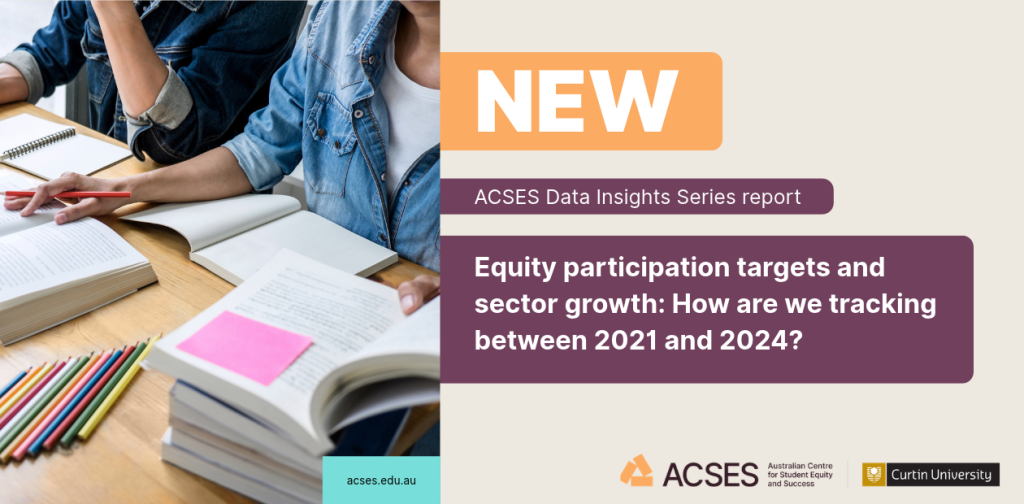
Our Data Resources Hub has continued to grow. We released two new Data Insights reports (on student retention and mode of attendance) and added two more Student Equity Data Guides. In collaboration with our Visiting Scholar Geoffrey Mitchell, we also launched the Education Data Sources table, a searchable table bringing together 103 publicly available datasets spanning schooling, higher education, VET, tertiary admission centres (TACs), post-school transitions, and population statistics.
We also had some team changes this year. We farewelled our senior data scientist Gobi in August and welcomed David, who brings strong skills and has settled in quickly.
Looking ahead to 2026, we’ll keep building our connections across the sector, release new reports—on topics including intersectionality and enabling program analyses—and keep improving transparency in equity data to support student success.
Sincerely
Associate Professor Gemma Cadby
ACSES Data Program Director

ACSES Research and Policy Program
2026 was another fabulous year for the Research and Policy Program. As always, the activities of the program are underpinned by a fantastic group of people, and I thank the hard work of the staff and contributors beyond who have provided valuable input into our activities.
Selected highlights of the Research and Policy Program for 2025 and a peek into our activities for 2026 are:
- The Fellowship Forum in March 2025 at Curtin University, where we celebrated and heard from ACSES First Nations and Equity Fellows funded in 2024 on the findings from their respective Fellowships. Four of the Fellowship reports have also been published and are available on the ACSES website.
- We funded ten projects under the ACSES Small Grants Research Program. The projects funded under the ACSES Small Grants Research Program in 2024 have been completed and are in the process of being published, with two already available on the ACSES website and eight in the production process.
- Five HDR projects were funded under our ACSES HDR Student Stipends initiative. Three of our 2024 HDR Student Stipends awardees presented the outcomes of their funded research at a webinar. Keep an eye out for the other HDR student presentations in 2026!
- We hosted Visiting Scholars Assistant Professor Franziska Lessky from the University of Innsbruck (Austria) and Adjunct Professor Seán Bracken from the University of Worcester (UK). Franziska’s project was titled “Does combining work and study ‘pay off’? Critically investigating graduate outcomes of students from equity groups” and Seán’s project was titled “The development of a leadership framework for enabling systemic inclusion in higher education”.
- We launched the inaugural ACSES 2025 Awards for Innovation and Excellence in Impact on Higher Education Policy and Practice. Congratulations again to all winners!
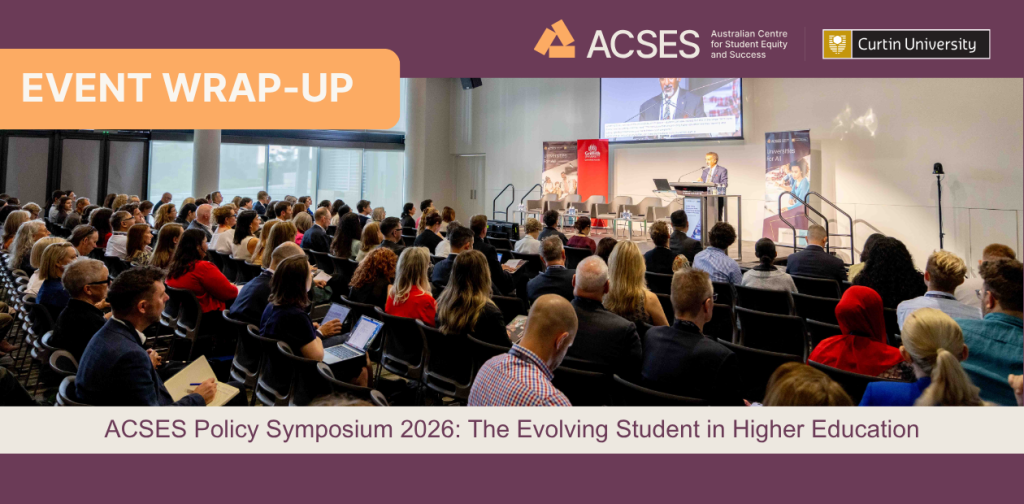
- The ACSES Policy Symposium was run for the second time in 2025, supported and hosted by the Centre for Social Justice and Inclusion at the University of Technology Sydney. Big ideas and discussion on Australian higher education policy and equity were shared during the symposium. We were also delighted to launch the inaugural ACSES Equity Insights report, sharing blue skies ideas from contributors around the sector on how to make Australian higher education fairer and more equitable.
- Planning for the 2026 ACSES Policy Symposium is underway. We are looking forward to meeting everyone and talking about all things student equity related in sunny Brisbane in the second half of 2026!
2025 also saw some personnel changes in the program. Our research assistant Varun Mehta departed in the pursuit of postgraduate studies at Boston University, but we were delighted to welcome Vince Gingoyon, a recent economics honours graduate from the University of Western Australia. We were also joined by Dr Novia Minaee, a biostatistician who has joined the program as a research fellow and Mr Andrew Hone, who is project manager for the program.
The Research and Policy Program is bustling with activity, and we are looking forward to continued collaborations with stakeholders and fundees in 2026.
Sincerely
Professor Ian Li
ACSES Research and Policy Program Director

ACSES Trials and Evaluation Program
In 2025, we completed the full rollout of our Trials Program, which supported a diverse range of randomised controlled trials and quasi-experimental studies. Most of these trials are due to wrap up in late 2026 and early 2027, and we’re looking forward to sharing the findings with the sector.
Alongside our trials funding, we were excited to launch two new schemes. Through our Practitioner Resource Grants Program, we supported stakeholders to create and share a wide range of equity resources, including best-practice guidelines, surveys and instruments, and digital tools. These resources will be released online across 2026 and 2027.
We also introduced our Capacity Building Grants, which provide funding directly to equity practitioners. These grants are helping universities build their capability to evaluate equity initiatives—for example, by working with evaluation experts, strengthening cross-institutional collaboration, and offering professional development opportunities for staff.
2025 marked the launch of the first two evaluation training modules on our Equity Hub website. These free modules are designed to help equity practitioners build their evaluation skills, with content ranging from introductory concepts through to advanced master classes. It’s been fantastic to see so many people already signing up.
Finally, we launched our Impact Evaluation Provider Directory, making it easier for stakeholders to connect with trusted experts in impact evaluation.
As we move into 2026, we’re excited to keep working with the broader equity community—both online and face-to-face.
Sincerely
Associate Professor Tim Pitman
ACSES Trials and Evaluation Program Director
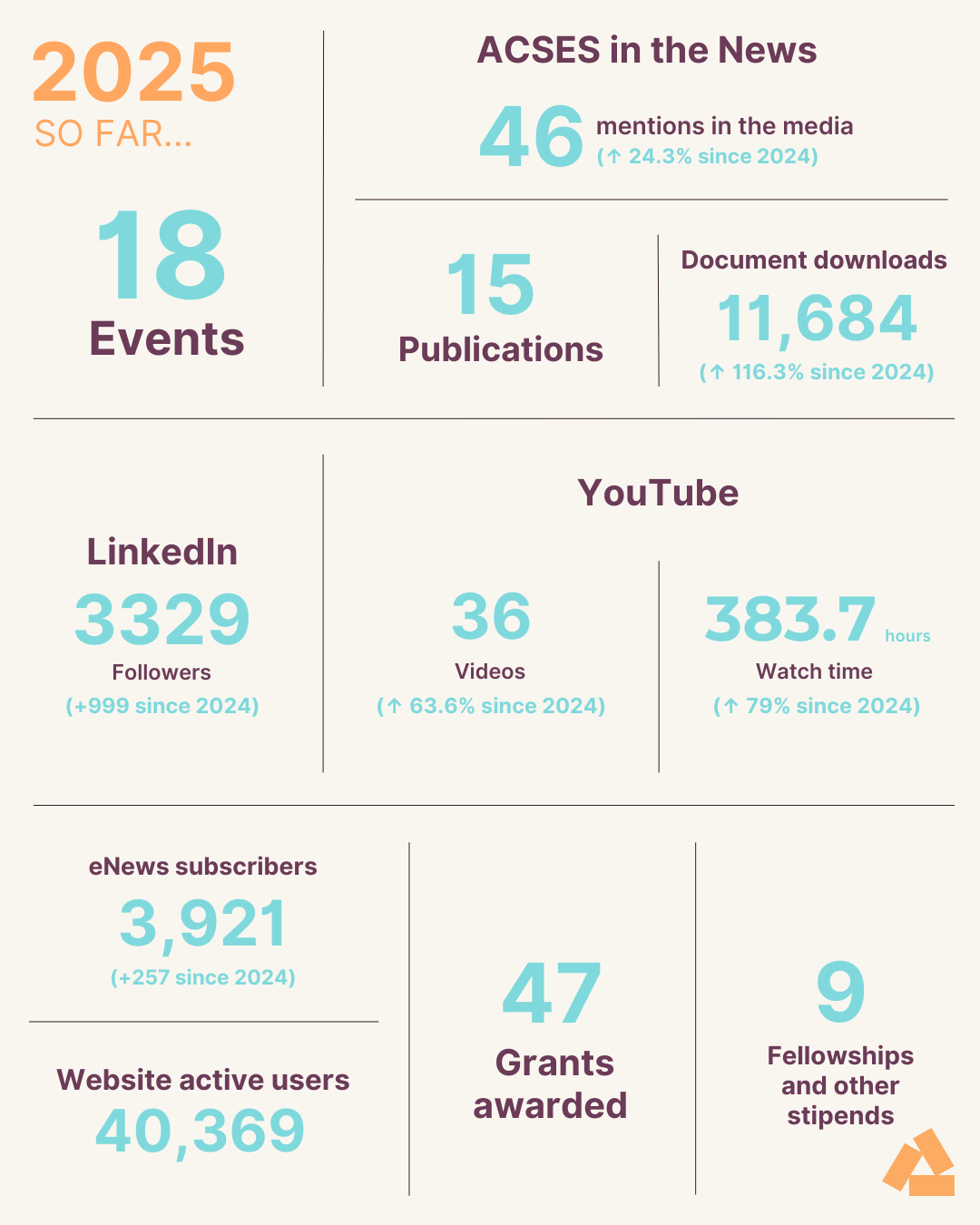
A quick look into what we have achieved…