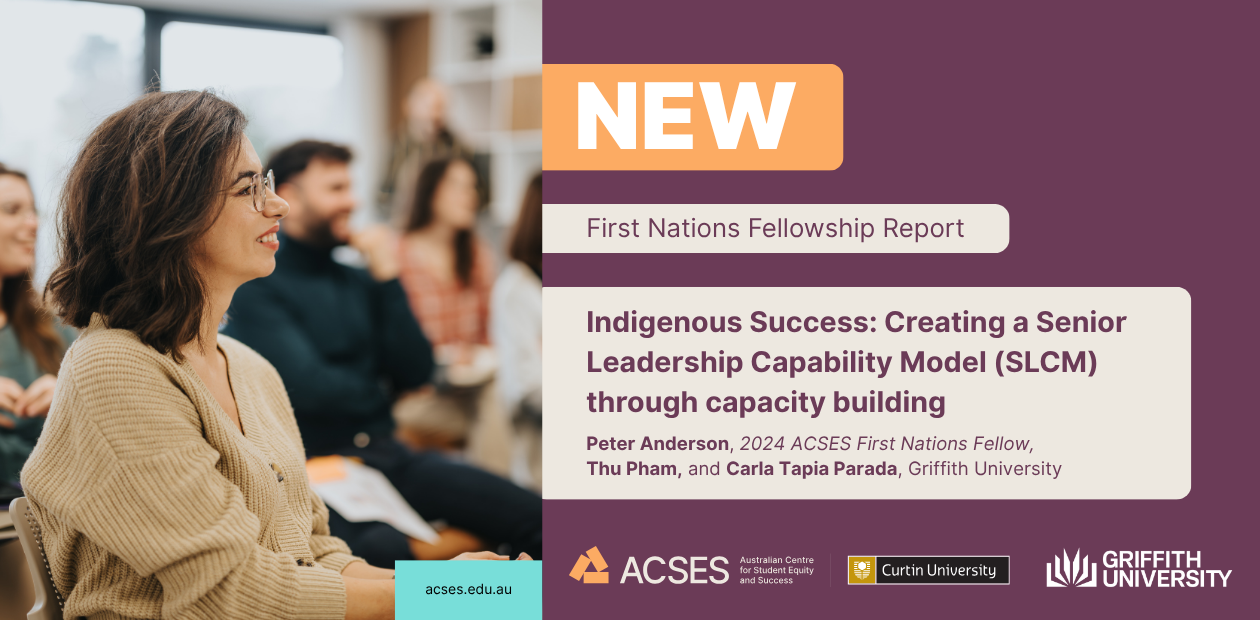
The Australian Centre for Student Equity and Success (ACSES) has today released a new First Nations Fellowship report identifying a unique framework for university leaders to foster Indigenous success in higher education.
The report finds while universities may have Indigenous strategies, many struggle with implementing them. Indigenous staff are also often burdened with an excessive “cultural load” by taking on extra responsibilities for Indigenous initiatives.
Authored by University of New England Pro Vice-Chancellor Indigenous Professor Peter Anderson (formerly Griffith University) and supported by Dr Thu Pham and Dr Carla Tapia Parada (Griffith University), Indigenous success: Creating a Senior Leadership Capability Model (SLCM) through capacity building presents findings on how shared responsibility among Indigenous and non-Indigenous staff can create more inclusive and equitable university environments.
Exclusively tailored for university leaders, the SLCM champions embedding cultural competency and nurturing genuine partnerships for lasting institutional change and driving Indigenous higher education success.
Professor Anderson said the report’s recommendations focus on fostering Indigenous success through shared responsibility across all levels of leadership.
This includes developing clear accountability measures for senior leadership and their teams in Indigenous engagement, establishing genuine partnerships with Indigenous communities, creating portfolio-specific training programs that build leadership capacity, and distributing responsibilities more equitably between Indigenous and non-Indigenous staff to ensure Indigenous success becomes core business for the entire institution.
“I am eager to share this pivotal work to enhance the capabilities and confidence of our colleagues across the Australian higher education sector, fostering an environment where we can collectively drive meaningful change for Aboriginal and Torres Strait Islander peoples and communities,” Professor Anderson said.
ACSES Research and Policy Program Director Professor Ian Li said promoting and supporting Indigenous success was vital to widening participation in higher education
“The SLCM will support the necessary frameworks to ensure an inclusive and equitable environment within higher education institutions and their staff members,” Professor Li said.
Key findings
- Despite universities having Indigenous strategies, many struggle with actual implementation, often resulting in isolated efforts rather than widespread, meaningful change.
- A significant gap exists where university leaders feel confident in Indigenous engagement but lack extensive practical experience, pointing to a need for deeper cultural understanding.
- Indigenous staff are often burdened with an excessive “cultural load,” taking on extra responsibilities for Indigenous initiatives, highlighting an urgent need for shared accountability across all leadership.
- Current cultural training often falls short, with a strong call for more specialised, practical development to genuinely embed Indigenous perspectives and drive systemic transformation.
Key recommendations
- Develop clear accountability measures for senior leadership in Indigenous engagement.
- Allocate dedicated resources for Indigenous programs and initiatives.
- Foster genuine partnerships with Indigenous communities.
- Create portfolio-specific training programs.
- Distribute responsibilities more equitably between Indigenous and non-Indigenous staff.
- Integrate Indigenous voices in strategic governance and decision-making.
- Establish support structures for all levels of university leadership.
For more information:
- Full report: Indigenous success: Creating a Senior Leadership Capability Model (SLCM) through capacity building
Media Contacts:
Anna Will, ACSES Communications and Stakeholder Engagement Manager (Interim)
Tel: (08) 9266 3948 Mobile: 0478 373 246 Email: anna.will@curtin.edu.au
Sam Jeremic, Corporate Communications Specialist, Curtin University
Tel: (08) 9266 3529 Mobile: 0407 601 993 Email : s.jeremic@curtin.edu.au
Peta MacDougall, Director Corporate Communications, University of New England
Tel: (02) 6773 2551 Email: media@une.edu.au
About the ACSES First Nations Fellowship program
The ACSES First Nations Fellowship program provides up to 12 months of funding to support First Nations researchers and/or practitioners to undertake impactful projects that advance equity in Australian universities. The aim is to support Aboriginal and Torres Strait Islander researchers to undertake projects that generate new knowledge, share lived experience, and shape more inclusive higher education systems. Fellowships are designed to build leadership, amplify First Nations voices, and foster collaboration between researchers, communities, and the higher education sector.