opening page ornament

The Australian Centre for Student Equity and Success acknowledges Indigenous peoples across Australia as the Traditional Owners of the lands on which the nation’s campuses are situated. With a history spanning more than 60,000 years as the original educators, Indigenous peoples hold a unique place in our nation. We recognise the importance of their knowledge and culture, and reflect the principles of participation, equity, and cultural respect in our work. We pay our respects to Elders past, present, and future, and consider it an honour to learn from our Indigenous colleagues, partners, and friends.

You are reading: Student Equity Data Guide: Higher Education Institutions in Australia

How many higher education institutions are there in Australia?

Australia is home to a total of 43 higher education institutions, which are divided into 38 Table A institutions, 4 Table B institutions, and 1 Table C institution. The Higher Education Support Act 2003 (HESA)[1] provides a list of higher education institutions and their classifications. This classification reflects differing levels of eligibility for funding and support from Commonwealth programs among these institutional types. For instance, only Table A institutions are eligible for Indigenous, Regional and Low SES Attainment Fund (IRLSAF) grants, while HECS-HELP is available for all award courses at Table A institutions but only for ‘national priority areas’ courses at Table B and Table C institutions[2]. There are also 155 non-university higher education institutes (NUHEPs)[3].

This guide focuses on Table A, B, and C higher education institutions, most of which are universities. Therefore, we will use ‘university’ within this guide for brevity.

How many students are enrolled at university in Australia?

In 2024, 746,369 domestic undergraduate students attended university in Australia, marking a 0.8% increase from 2023 (enrolment of 739,903)[4]. Approximately 98% of these students were enrolled at Table A universities and 2% at Table B universities. No domestic undergraduates were enrolled at the Batchelor Institute of Indigenous Tertiary Education (Table A) or at Carnegie Mellon University Australia (Table C). In 2024, about 53% of all domestic undergraduate students studied on campus, 19% studied externally, and the remaining 28% studied via a mixed mode.

What are the institutional groupings in Australia?

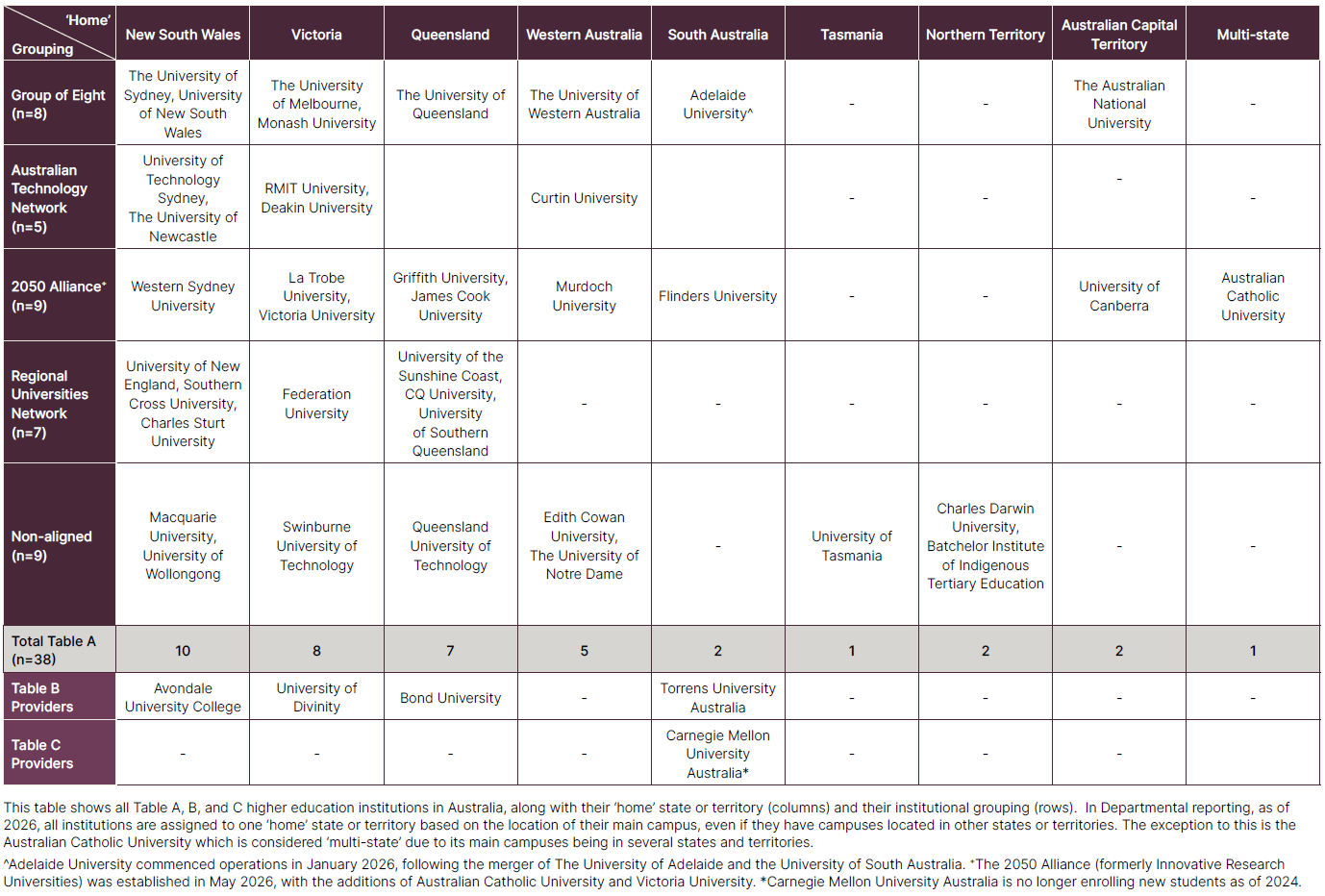
In Australia, institutional groupings are collaborations among Table A universities that share similar backgrounds, missions, and interests. These groupings promote common goals, resource sharing, and collaborative research and educational initiatives. The institutional groupings are: Group of Eight (Go8), Australian Technology Network (ATN), 2050 Alliance (formerly the Innovative Research Universities), and Regional Universities Network (RUN). Institutions not part of any grouping may be referred to as ‘non-aligned’.

All Table A, B, and C higher education institutions in Australia with their ‘home’ state or territory and their institutional grouping

Image of a table showing all Table A, B, and C higher education institutions in Australia, along with their 'home' state or territory (columns) and their institutional groupings (rows)


[1] https://www.legislation.gov.au/C2004A01234/latest/downloads

[2] https://www.aph.gov.au/About_Parliament/Parliamentary_departments/Parliamentary_Library/pubs/rp/rp2021/GovernmentFundingHigherEducation

[3] https://polis.cass.anu.edu.au/files/docs/2025/6/Mapping_Australian_higher_education_2023_005.pdf

[4] https://www.education.gov.au/higher-education-statistics/resources/perturbed-student-enrolments-pivot-table-2024

Last updated May 2026

Featured publications
A Small Grants Research Program final report. The study sought to explore how to support engagement for online students, thereby addressing issues of disengagement and attrition.
This study addressed this topic in the Australian context using data from the annual Student Experience Survey (2016–2020 waves) with linkage to administrative records for 24,292 students from seven higher education institutions.
An ACSES Equity Fellowship final report. The project looks at how Australian universities are managing challenges around the governance of equity data, which tracks how students from underrepresented backgrounds enrol, study, and succeed in higher education.
A Large Grants Research Program final report. The project is the first national, cross-institutional benchmarking and impact study of in-school enabling programs in Australia, examining models and outcomes with a focus on impact for equity groups.
More publications