opening page ornament

The Australian Centre for Student Equity and Success acknowledges Indigenous peoples across Australia as the Traditional Owners of the lands on which the nation’s campuses are situated. With a history spanning more than 60,000 years as the original educators, Indigenous peoples hold a unique place in our nation. We recognise the importance of their knowledge and culture, and reflect the principles of participation, equity, and cultural respect in our work. We pay our respects to Elders past, present, and future, and consider it an honour to learn from our Indigenous colleagues, partners, and friends.

You are reading: Student Equity Data Guide: Higher Education Institutions in Australia

How many higher education institutions are there in Australia?

Australia is home to a total of 43 higher education institutions, which are divided into 38 Table A institutions, 4 Table B institutions, and 1 Table C institution. The Higher Education Support Act 2003 (HESA)[1] provides a list of higher education institutions and their classifications. This classification reflects differing levels of eligibility for funding and support from Commonwealth programs among these institutional types. For instance, only Table A institutions are eligible for Indigenous, Regional and Low SES Attainment Fund (IRLSAF) grants, while HECS-HELP is available for all award courses at Table A institutions but only for ‘national priority areas’ courses at Table B and Table C institutions[2]. There are also 155 non-university higher education institutes (NUHEPs)[3].

This guide focuses on Table A, B, and C higher education institutions, most of which are universities. Therefore, we will use ‘university’ within this guide for brevity.

How many students are enrolled at university in Australia?

In 2024, 746,369 domestic undergraduate students attended university in Australia, marking a 0.8% increase from 2023 (enrolment of 739,903)[4]. Approximately 98% of these students were enrolled at Table A universities and 2% at Table B universities. No domestic undergraduates were enrolled at the Batchelor Institute of Indigenous Tertiary Education (Table A) or at Carnegie Mellon University Australia (Table C). In 2024, about 53% of all domestic undergraduate students studied on campus, 19% studied externally, and the remaining 28% studied via a mixed mode.

What are the institutional groupings in Australia?

In Australia, institutional groupings are collaborations among Table A universities that share similar backgrounds, missions, and interests. These groupings promote common goals, resource sharing, and collaborative research and educational initiatives. The five institutional groupings are: Group of Eight (Go8), Australian Technology Network (ATN), Innovative Research Universities (IRU), and Regional Universities Network (RUN). Institutions not part of any grouping may be referred to as ‘non-aligned’.

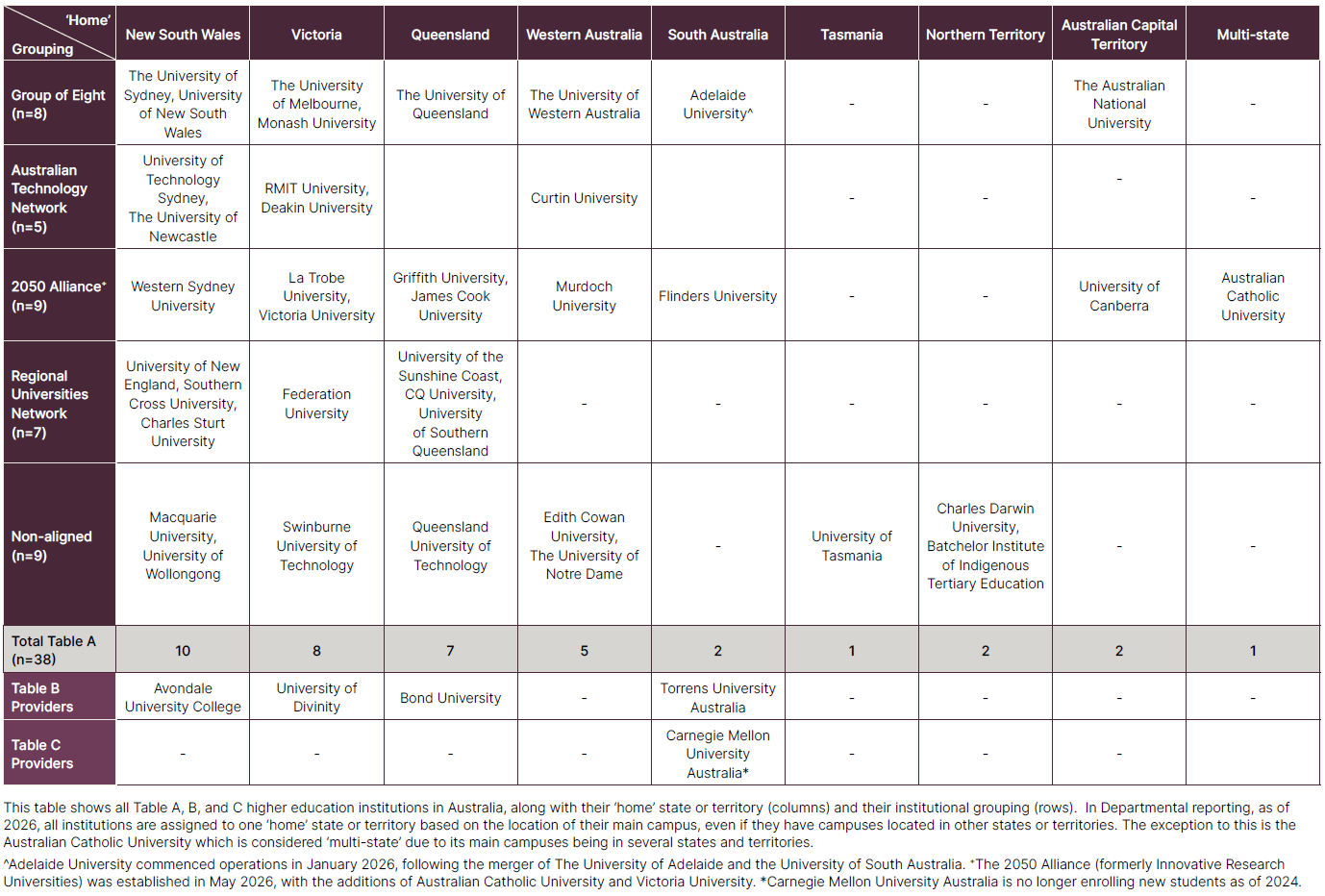
All Table A, B, and C higher education institutions in Australia with their ‘home’ state or territory and their institutional grouping

This table shows all Table A, B, and C higher education institutions in Australia, along with their ‘home’ state or territory (columns) and their institutional grouping (rows). In Departmental reporting, as of 2024, all institutions are assigned to one ‘home’ state or territory based on the location of their main campus, even if they have campuses located in other states or territories. The exception to this is the Australian Catholic University which is considered ‘multi-state’ due to its main campuses being in several states and territories. *Carnegie Mellon University Australia is no longer enrolling new students as of 2024.


[1] https://www.legislation.gov.au/C2004A01234/latest/downloads

[2] https://www.aph.gov.au/About_Parliament/Parliamentary_departments/Parliamentary_Library/pubs/rp/rp2021/GovernmentFundingHigherEducation

[3] https://polis.cass.anu.edu.au/files/docs/2025/6/Mapping_Australian_higher_education_2023_005.pdf

[4] https://www.education.gov.au/higher-education-statistics/resources/perturbed-student-enrolments-pivot-table-2024

Last updated January 2026

Featured publications
A case study documenting the transition of one Indigenous student, Robbie, from an underprivileged school located in the Western suburbs of Sydney to an urban Australian university.
A Small Grants Research Program final report. The study returned to a diverse cross-section of schools in the Aspirations Longitudinal Study (2012-2015) to understand how students’ views about their futures had changed over the past decade.
An ACSES First Nations Fellowship final report. This project created a Senior Leadership Capability Model (SLCM), which is a unique framework specifically designed for university leaders to foster Indigenous success in higher education.
An ACSES Equity Fellowship final report. Using a mixed methods approach, this study offers new insights, including a typology of Regional University Study Hub models and key recommendations to strengthen the program’s impact on student success.
More publications