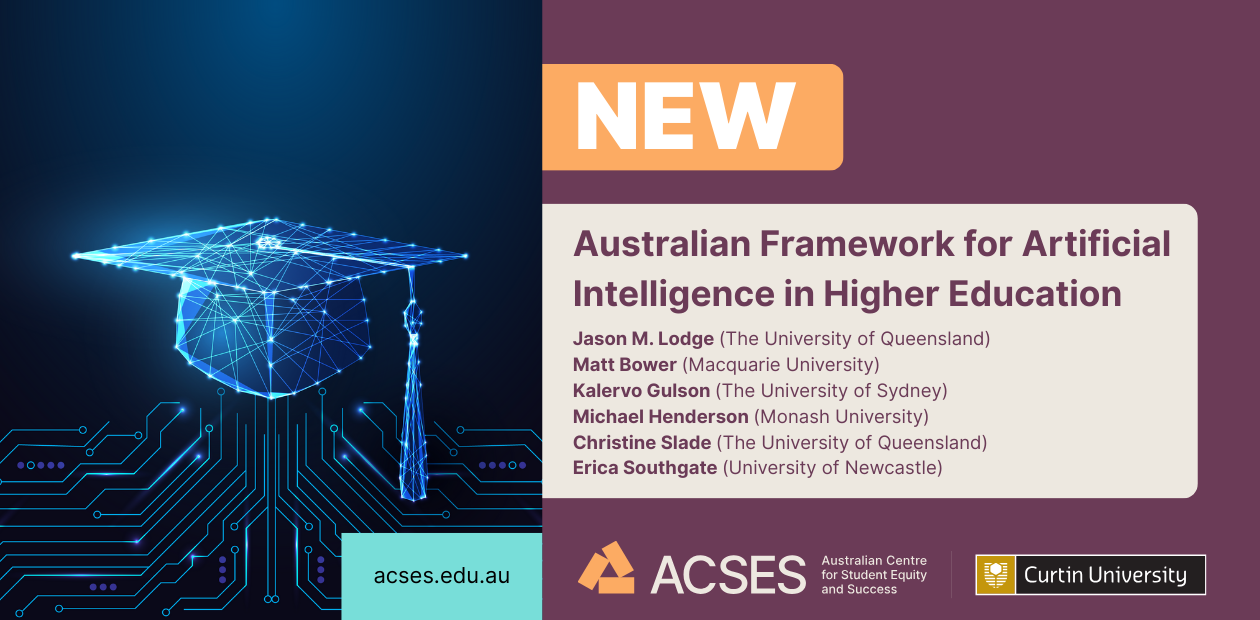
The Australian Centre for Student Equity and Success (ACSES) has today published The Australian Framework for Artificial Intelligence in Higher Education, which sets out to provide guidance to higher education institutions on how they implement AI.
The Framework outlines both the transformative powers and potential challenges faced by the continued use of AI in higher education, with a central focus on the need to maintain equity and ethical innovation.
While AI technology is constantly advancing, the Framework addresses the immediate need for higher education institutions to maintain core principles such as human-centred learning and research integrity while investing in AI integration.
Lead author Professor Jason Lodge, from the University of Queensland, said the challenges AI poses in higher education cannot be solved by a single institution and the Australian sector must share the responsibility for AI innovation rather than competing.
“Our central focus with this Framework is equity: we cannot allow AI integration to amplify existing digital divides,” Professor Lodge said.
“Instead, we must proactively ensure these technologies enhance educational opportunity for all students.”
ACSES Research and Policy Program Director Professor Ian Li said the Framework will pave the way for the industry collaboration needed to reap the educational benefits of AI and avoid its pitfalls.
“AI has the potential to benefit students in their education, but could also exacerbate inequality in educational outcomes, particularly for students from equity backgrounds,” Professor Li said.
“The Framework provides useful guidance for the sector to navigate opportunities and challenges from AI in education.”
A collaborative project, the Framework’s authors include Professor Lodge, Professor Matt Bower (Macquarie University), Professor Kalervo Gulson (University of Sydney), Professor Michael Henderson (Monash University), Associate Professor Christine Slade (University of Queensland), and Associate Professor Erica Southgate (University of Newcastle), with the Australian National AI in Schools Taskforce.
Key highlights include:
- Human-centred education: The use of AI in higher education institutions must be treated with caution to ensure human-centredness remains a core focus. Human connection, critical thinking and equity must be prioritised.
- Ethical and inclusive deployment: Ethical standards must be maintained when implementing or developing AI use in higher education. Universities and placement sites must ensure that the integration of AI benefits all students.
- Policy development: A range of affected stakeholders – including government officials, academic staff and students and active researchers, with an emphasis on those from diverse backgrounds – should collaborate in addressing key areas of higher education affected by AI and implement policies to address these areas.
- Professional learning: Universities and professional bodies should strive to become more educated in AI advancements so that the implementation of such technology can be utilised to its full potential.
- Integrity in research: The implementation of AI can lead to complications, such as when generative AI is used to produce and analyse data which can introduce errors. Policies and procedures must be designed to maintain academic integrity.
Read the full Framework here: Australian Framework for Artificial Intelligence in Higher Education
Media Contacts:
Anna Will, ACSES Communications and Stakeholder Engagement Manager (Interim)
Tel: (08) 9266 3948 Mobile: 0478 373 246 Email: anna.will@curtin.edu.au
Sam Jeremic, Corporate Communications Specialist, Curtin University
Tel: (08) 9266 3529 Mobile: 0407 601 993 Email : s.jeremic@curtin.edu.au