Event information
Online via Zoom
The Australian Centre for Student Equity and Success (ACSES) is committed to developing research capacity in Australian higher education equity, especially through its support of the next generation of equity researchers.
This includes engaging, collaborating with, and funding students to conduct research on Australian higher education equity issues. The ACSES Higher Degree by Research (HDR) Stipend Scheme provides supplementary funding to higher degree by research students enrolled in an Australian university (Table A and Table B providers) to undertake a research project relating to Australian higher education student equity that leads to the publication of a journal article. The scheme is intended to encourage the translation of research to practice, evaluation, and policy in student equity.
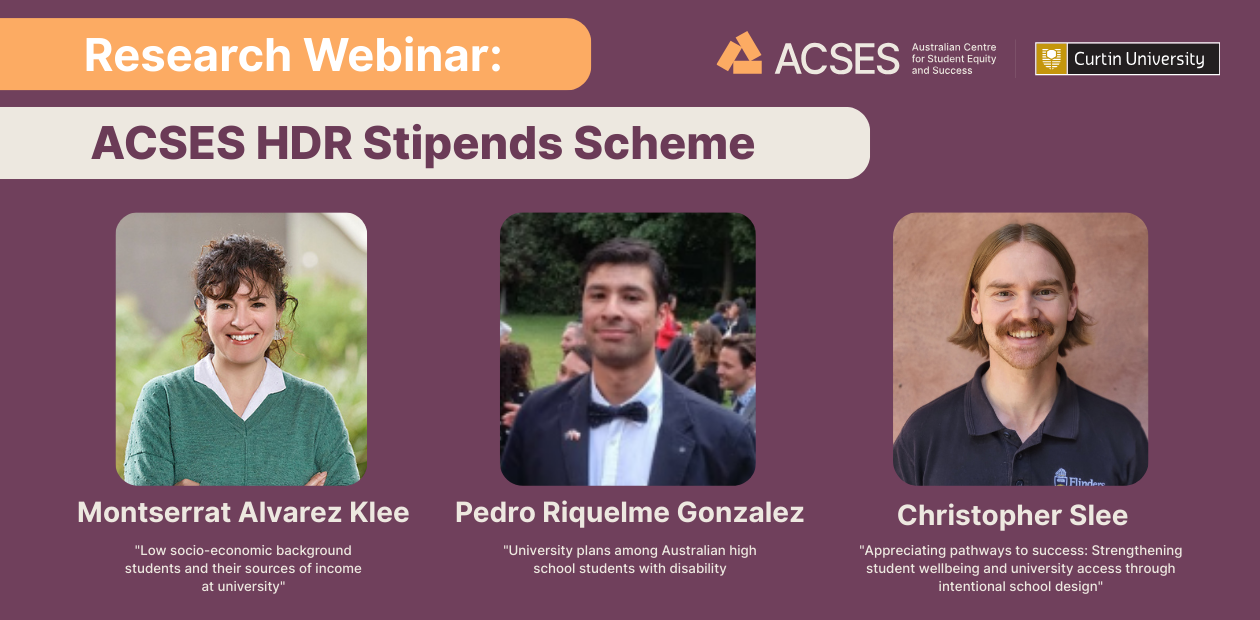
ACSES is pleased to host this webinar, which will feature presentations from three recipients from the 2025-26 Round of the HDR Stipend Scheme.
About the speakers:
Montserrat Alvarez Klee
Project: Low socio-economic background students and their sources of income at university
The aim of this project is to undertake an analysis on Australian university students from low socio-economic status (SES) backgrounds and their sources of income at university. This analysis will identify which sources of income are more prevalent and have a greater impact on university completion.
About the presenter:
Montserrat is a PhD student at POLIS: The Centre for Social Policy Research at the Australian National University (ANU). She holds a Graduate Certificate in Social Research from ANU.
She has previously worked as a Research Officer on a range of social science research projects at both ANU and the University of Canberra.
Driven by a strong commitment to equity in education, Montserrat commenced her PhD to investigate how socio‑economic background shapes access to university in Australia over the past century. Her doctoral research is a quantitative study, with a major component focusing on Youth Allowance and its impact on university attainment among students from low socio‑economic backgrounds.
Pedro Riquelme Gonzalez
Project: University plans among Australian high school students with disability
This study aimed to explore how disability shapes educational expectations among Australian high school students. Despite being disproportionately affected by lower retention rates, completion, and attainment compared to their non-disabled peers, the aspirations for higher education of students with disability remain poorly understood. By examining the intersection of disability, academic aspirations, and student engagement, this study offers novel insights into how the presence of disability affects educational aspirations.
Using data from the second wave of the GENERATION Study, this comparative study explored the university plans of approximately 2,000 Australian Year 11 students. Through a mixed-method design, we examined how disability influenced aspirations among students with disability. We also investigated whether the views of this group differ from those expressed by students without disability. We also estimated multilevel models to test associations between disability, type and number of reported difficulties, and plans to attend university.
Findings reveal that disability is generally associated with lower intentions to pursue higher education, but effects vary by disability type and the number of difficulties experienced. Student engagement variables moderated disability-related gaps, depending on the level of difficulty faced by students.
About the presenter:
Pedro is a PhD student at POLIS: The Centre for Social Policy Research at the ANU. His academic background is in sociology, with a focus on youth studies and identity construction within urban youth cultures. His work employs identity theory and symbolic interactionism frameworks to analyse social phenomena. As a master’s student, his thesis explored acquired physical impairments and identity changes during youth. Currently, he is examining the interaction between student identity and disability status and how the latter impacts students’ expectations for further education.
Christopher Slee
Project: Appreciating pathways to success: Strengthening student wellbeing and university access through intentional school design
Australian students completing their final year of school (year 12) routinely experience higher levels of psychological distress arising from pressures to achieve an Australian Tertiary Admissions Rank (ATAR) needed to apply for university. Increasingly, schools and universities offer alternate admission pathways to circumnavigate the ATAR and address low rates of university admission from student equity groups. However, limited evidence exists reporting on their ability to enhance university access whilst supporting a student’s wellbeing during their final year of studies. This presentation reports on preliminary insights gained from 10 Appreciative Inquiry interviews conducted with senior secondary students (N = 7) and staff (N = 3) of a South Australian senior secondary specialist sports school that offers a non-ATAR pathway—the Portfolio Entry (PE). Findings revealed participants saw beyond the dualistic conception of pursuing an ATAR or PE pathway suggesting instead pathway options should be intentionally weaved into a school’s design and student experience to foster positive wellbeing and enhance aspirations and ability to attend university. A student’s successful pathway to university was characterised by an accumulation of factors across their time in school including establishing an intrinsic connection to curriculum content to support engagement in learning, studying within a positive school climate built around support, and embedding career exploration experiences throughout school to enhance the development of career goals and identity. Admission pathways were characterised by a student having choice and back-up options aligned to their self-identified needs. Together, these create the conditions for students to not only flourish, but enhance university access. Findings can be used by schools and the Australian tertiary education sector to consider how university admissions pathways and the school experience can be intentionally designed to enhance student wellbeing and university access.
About the presenter:
Chris Slee is an industry-funded PhD candidate at Flinders University where he is working in partnership with a South Australian senior secondary specialist sports school to conduct a case study of student wellbeing within its unique, sports-centred learning environment. His research is inspired through his working background in youth mental health and tertiary education sectors where he worked closely with high school students experiencing dissatisfaction with their education. He advocates for alternative school models that challenge the status quo and create environments where every student can find their place. Outside of his studies, Chris often finds himself with a tennis racquet in hand or on the soccer field (provided he’s not recovering from his latest injury!).
Webinar recording
A recording of the Research Webinar can be viewed here.