Event information
Online via Zoom
The Australian Centre for Student Equity and Success (ACSES) is committed to developing research capacity in Australian higher education equity, especially through its support of the next generation of equity researchers.
This includes engaging, collaborating with, and funding students to conduct research on Australian higher education equity issues. The ACSES Higher Degree by Research (HDR) Stipend Scheme provides supplementary funding to higher degree by research students enrolled in an Australian university (Table A and Table B providers) to undertake a research project relating to Australian higher education student equity that leads to the publication of a journal article. The scheme is intended to encourage the translation of research to practice, evaluation, and policy in student equity.
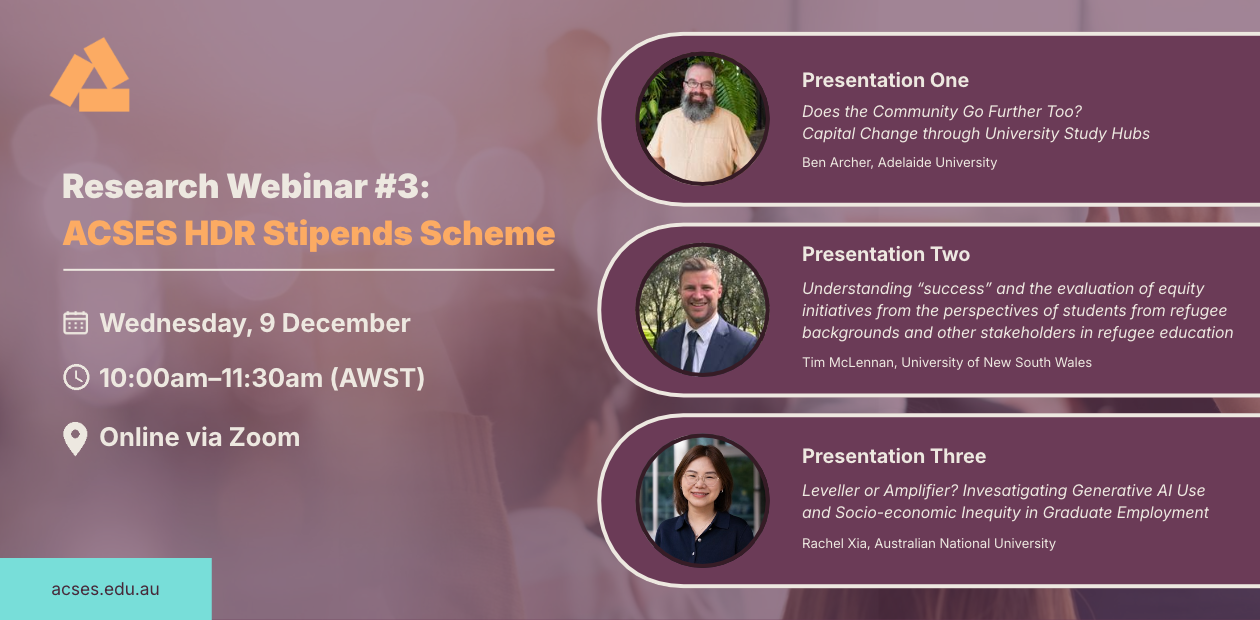
ACSES is pleased to host this webinar, which will feature presentations from three recipients from the 2025-26 Round of the HDR Stipend Scheme.
Presentation One | Does the Community Go Further Too? Capital Change through University Study Hubs by Ben Archer
Study Hubs are usually described by what they give individual students, such as a place to study, reliable internet and support without having to leave town. Far less attention has gone to whether that support changes the wider community, and hubs were absent from all four university mission-based compacts reviewed for this project. Drawing on Bourdieu’s concepts of capital, habitus, hysteresis, and illusio, the research asks how a hub shifts the way things are done locally and whether university becomes a game worth playing. Taree Universities Campus is the pilot site for this work, which will extend to a five-site case study across regional Australia. Two scoping reviews, including a Bourdieusian analysis of 184 articles, suggest that educational access and economic capital work together in regional communities. This places a larger widening participation responsibility on hubs, which they can only meet through genuine partnership with universities. Data from the Longitudinal Surveys of Australian Youth are being used to set a baseline for communities like Taree, while a student survey is underway and interviews will follow once ethics is approved. The presentation shares where this work is up to and considers whether going further, closer to home, can reach beyond the individual student to the town itself.
About the presenter:
Ben Archer is a PhD candidate at Adelaide University whose research examines how educational access, religious belief, and workforce development shape career pathways in rural, remote, and regional communities. His work looks at how the availability of education interacts with local religious and cultural frameworks to influence career choices, both for individuals and for whole communities. He also studies how non-urban organisations can plan their future workforce around local educational infrastructure and culture, with implications for educational policy, regional development, and organisational practice.
Presentation Two | Understanding “success” and the evaluation of equity initiatives from the perspectives of students from refugee backgrounds and other stakeholders in refugee education by Tim McLennan
This presentation will report on the findings of a participatory co-design project focused on how students from refugee backgrounds (SfRB) and other stakeholders in refugee education define success and how it can be evaluated in higher education. I will discuss key themes on “success” at university relating to recognition, belonging, and connectedness and navigating university, careers, and life. I will also discuss findings on how evaluation can be more tailored for SfRB, such as through evaluators utilising participatory approaches, being trauma-aware, prioritising safety, trust and transparency, encouraging peer collaboration, recognising the heterogeneity of SfRB, and adopting an intersectional lens.
About the presenter
Tim is a final year PhD candidate in the School of Education at UNSW, supervised by Associate Professor Rose Amazan (UNSW) and Associate Professor Sally Baker (Refugee Education Australia and UNSW). Tim’s academic background includes a Bachelor of Science with honours majoring in physiology, and a Master of Higher Education from the University of Otago. While working as an education focused academic, Tim developed an interest in equity in education, which led him to his current research focus on refugee education.
Presentation Three | Leveller or Amplifier? Investigating Generative AI Use and Socio-economic Inequity in Graduate Employment by Rachel Xia
Generative artificial intelligence (GenAI) has the potential to level the playing field for university students entering the labour market by making sophisticated job application support more accessible. Yet, its benefits may not be equally distributed across students from different socio-economic backgrounds. This presentation explores how students’ socio-economic backgrounds shape their engagement with GenAI and, in turn, the quality of their job applications. Drawing on an empirical study of Australian university students, the findings suggest that socio-economic inequalities may persist even when students have access to the same AI tools. These findings raise important questions about how higher education institutions can support equitable access to graduate employment opportunities in an increasingly AI-enabled labour market.
About the presenter
Rachel Xia is a Lecturer in Management at the Australian National University. Her research focuses on socio-economic inequality in employment, personnel selection, and the implications of AI for workplace equity. Her research has been published in Human Resource Management and recognised through the 2026 SIOP Zedeck–Jacobs Award. She is passionate about advancing fair and evidence-based employment practices.