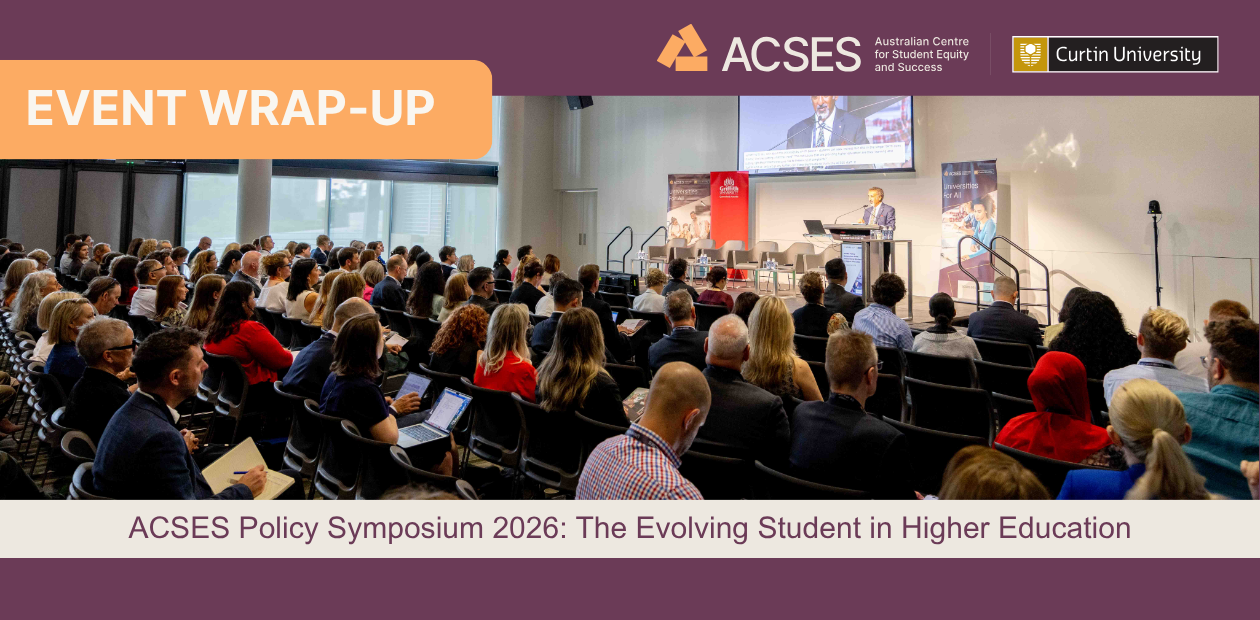
Nearly 200 university leaders, policymakers, academics, and student equity experts from across Australia convened for two days of robust discussion at the ACSES Policy Symposium 2026 in Queensland last week.
Held at the Brisbane Convention and Exhibition Centre on 8–9 September, the Symposium brought together 200 in-person attendees—including around 50 guest speakers—and close to 700 online registrants.
The theme, The Evolving Student in Higher Education, inspired a broad range of presentations and panel discussions examining practical, evidence-based solutions for driving impactful change in student equity policy and practice. An interactive Q&A kept audience members engaged from start to finish, enabling them to quiz and critique speakers on some of the timeliest issues facing the sector.
ACSES Executive Director Professor Shamit Saggar said this year’s event, delivered with support from Griffith University, was the biggest and most well-received to date.
“In just three years, the ACSES Policy Symposium has cemented itself as one of Australia’s foremost annual gatherings for advancing student equity in higher education,” Professor Saggar said.
“On behalf of everyone at ACSES, we are immensely grateful: to our guest speakers, for sharing their expertise and perspectives; and to everyone who attended or watched the livestream, for supporting this crucial event.”
A full summary of event highlights is provided below, and livestream recordings for each session will be made available soon. You can also view the full photo gallery via the links below:
Symposium summary
Day One | Tuesday, 8 September
Professor Saggar started Day One with an Acknowledgement of Country, paying respect to the Yuggera and Turrbal people of the Meanjin (Brisbane) area. In his welcome address, he spoke about the need for institutions to adapt to the changing equity landscape, with many recommendations of the 2024 Australian Universities Accord Final Report now being implemented by the Australian Tertiary Education Commission (ATEC). Next came a formal welcome from Griffith University’s Acting Provost Professor Shaun Ewen, followed by opening remarks from ACSES Research and Policy Program Director Professor Ian Li. Professor Ewen referred to the ambitious targets of the Accord and touched on the need for genuine partnerships between universities and students, noting: “We won’t get there by doing what we already do”. Professor Li unpacked this year’s theme and why it “matters more than ever”, explaining how equity “has moved from the margins of student experience to the centre”.
Panel 1: The Evolving Student—Challenges Faced Beyond Academia
Griffith University’s Dr Sakinah Alhadad moderated the first panel of the day, The Evolving Student—Challenges Faced Beyond Academia, which featured student panellists Seth Bishop (UniSQ), Oliver Brown (Griffith University), Luke Gilbert (QUT), Abijah Fonoti (UniSC), and Aanavi Raj (UQ). In the discussion that followed—cited by many participants as an event highlight—panellists explored the increasingly complex and intersecting challenges facing today’s students, drawing on their own lived experiences of life, study, and work. Common themes included financial hardship, food insecurity, housing instability, mental health, and the burden of excessive university bureaucracy on disadvantaged students seeking support. Mr Gilbert spoke candidly about juggling four jobs while studying and overcoming mental health issues. Mr Brown shared how homelessness had forced him to postpone plans to complete a master’s degree. “I’ve been mourning that decision for a few months, and it has really changed my perspective on study,” he said.
Keynote address: Luke Sheehy, Universities Australia CEO
Universities Australia CEO Luke Sheehy delivered the first keynote address, calling on governments to provide more practical cost-of-living relief including concession cards and subsidised public transport for all domestic students. “Students are investing years of their lives building the skills Australia needs—we should back them while they do it,” he said. Mr Sheehy also spoke about the need to better serve disadvantaged students—particularly those from low socio-economic status backgrounds, regional and remote areas, and who are first-in-family to attend university—if Australia is to lift higher education participation and grow its skilled workforce.
Keynote address: The Hon. Jason Clare MP, Minister for Education
Federal Minister for Education Jason Clare delivered the second keynote address, highlighting the Albanese Government’s efforts to “bend the system to make it fairer” for “people from poor families, the regions, and the bush to get a crack at university”. Speaking via video recording, Minister Clare said this required “changing the whole education system, not just universities, and it sometimes means doing things not everyone likes”. He cited initiatives including the new marginal repayment system for student debt, the Commonwealth Prac Payment, Needs-based Funding, and the establishment of ATEC.
Panel 2: From Access to Equity: Rethinking Higher Education for First Nations Students
The second panel, From Access to Equity: Rethinking Higher Education for First Nations Students, saw Professor Ewen return to the stage as moderator. Joining him were Angela Barney-Leitch (Griffith University), Damien Miller (Atlantic Fellows for Social Equity), and Kim Robertson (Oodgeroo Unit, QUT). Ms Barney-Leitch touched on the need to “reframe how we talk about Indigenous units within universities”, including shifting the focus “from student deficit to institutional capability”. Ms Robertson spoke about issues including the need for more gender equity in university leadership, and the ongoing impact of the historical exclusion of Indigenous Australians from higher education. “Success means so much more to us and our people … because of the fact that these institutions were built to exclude us,” Ms Robertson said.
Panel 3: Driving Success for Part-Time Students
Associate Professor Kelly Linden (Charles Sturt University) led the third panel, Driving Success for Part-Time Students, which featured Alarnah McKee (UNSW), Professor Kylie Readman (UTS), Professor Jonathan Powles (CQUniversity), Professor Adam Shoemaker (VU), and Associate Professor Amanda White OAM (UTS). Associate Professor Linden drew on the findings and recommendations of her recently published ACSES Equity Fellowship report, which examined the increasingly complex challenges facing part-time university students and the interventions needed to help them succeed. She spoke about the need for more flexible and inclusive university policies, noting that part-time study was “one of the biggest risk factors for success and retention”, with this growing student cohort increasingly juggling work and caring responsibilities.
Keynote address: Professor Bronwyn Fredericks, Deputy Vice-Chanceller (Indigenous Engagement), The University of Queensland
In the third keynote address, UQ Deputy Vice-Chanceller (Indigenous Engagement) Professor Bronwyn Fredericks explored “the ebbs and flows of student life” with a focus on challenges faced by Indigenous students and those from intersecting equity backgrounds, including low socio-economic status, regional, and remote areas. Professor Fredericks also highlighted the need for more Indigenous people to be employed in roles that “cut across all jobs in university”. She asked: “Why is it that we are quarantined, blocked, garnished into Indigenous helping roles, service roles, to assist the university or do the academic housework or the domestic administrative housework?”
Panel 4: Tertiary System Collaboration and Student Pathways
2050 Alliance CEO Paul Harris moderated the final session for the day, Tertiary System Collaboration and Student Pathways, which featured panellists Professor Sue Bennett (La Trobe), Professor Tania Broadley (ACU), Wayne Butson (VU), and David Coltman (ATEC). The discussion explored efforts by the Federal Government and institutions to harmonise the tertiary education system, amid growing numbers of students entering university through “non-traditional” pathways. Mr Harris explained how increased participation targets now being implemented by ATEC were heavily focused on this approach, with panellists exploring the resulting challenges and opportunities. Mr Coltman, who is an ATEC Commissioner and served previously as CEO of TAFE SA, provided valuable insights on the benefits of a more “joined-up” tertiary system, and shared details of ATEC’s work on a more nationally consistent credit recognition framework.
Dinner and Awards Night
Day One finished with a gala dinner and the announcement of the 2026 ACSES Awards winners. This year’s Awards recognised five winning teams across four categories:
- Evidence and Research-Based Approach: Tapping and strengthening the talents: Inclusive Education and Employment Pathways for Autistic Individuals – Autism Academy, Autism-Specialist Mentoring Program and Curtin Autism Research Group, Curtin University
- Innovation and Originality: Dilin Duwa Centre for Indigenous Business Leadership, The University of Melbourne
- Innovation and Originality: The Small Schools Program, University of Canberra
- Collaboration and Stakeholder Engagement: Employing Queensland: Innovative Pathways to Teaching (EQuIPT), Queensland University of Technology
- Impact and Effectiveness: Transforming Student Outcomes through the Southern Cross Model, Southern Cross University.
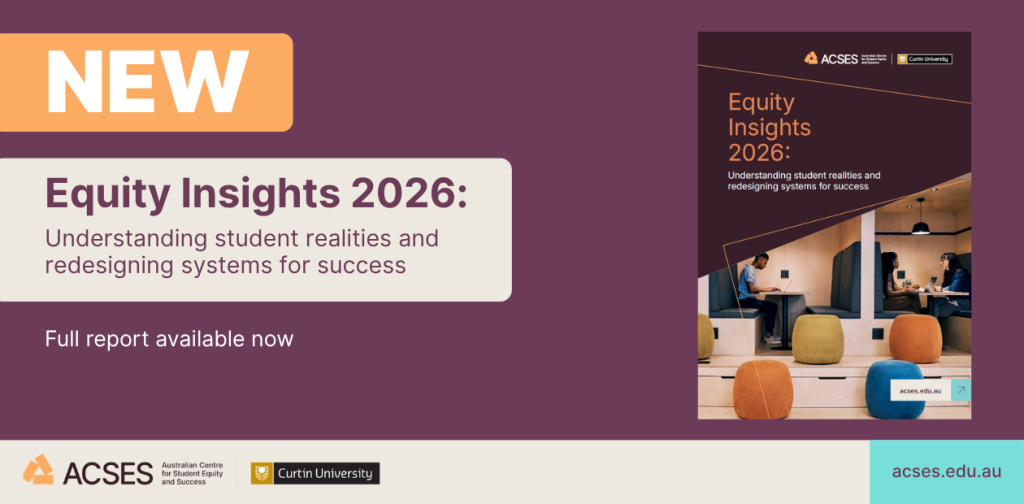
The night also included a presentation from Professor Karen Nelson (Western Sydney University), who spoke about systemic barriers to meeting the Australian Universities Accord’s target of 80% of the working-age population holding a tertiary qualification by 2050. “It is ambitious, admirable—and utterly impossible to achieve if institutions continue to behave as though academic success happens in a vacuum,” Professor Nelson said. Her presentation coincided with the launch of ACSES’s latest publication, Equity Insights 2026, featuring contributions from 20 of the sector’s leading voices including Professor Nelson.
Day Two | Wednesday, 9 September
Panel 5: Supporting Students Through Cost-of-Living Pressures
Day Two began with Panel 5, Supporting Students Through Cost-of-Living Pressures, moderated by Dr Kylie Austin, Director of Student Life at Edith Cowan University. She was joined by Dr Katherine Kent (University of Wollongong), Professor Alan Duncan (Bankwest Curtin Economics Centre), Professor Hayley Fisher (The University of Sydney), Distinguished Professor George Williams (WSU), and Jaidyn Roberts (UQ). The conversation centred on the multidimensional issue of student financial hardship and related issues such as food insecurity. It delved into recent research, potential system-level and institutional responses, and the everyday impacts on today’s university students. Reflecting on the past decade, Professor Duncan noted that “the economic margin for many students has almost disappeared”. Mr Roberts, an undergraduate student, shared his experiences of dealing with “intersecting barriers”, including being first-in-family to attend university and having to travel from regional Queensland to attend classes in Brisbane.
Book launch and discussion: Access and the Making of Mass Higher Education: From Workers to Students
The second session of the day saw the launch of Access and the Making of Mass Higher Education: From Workers to Students, a new book by Professor David Davies (University of Warwick) and Professor Jim Nyland (Southern Cross University). Professor Nyland, who is Associate Dean (Education) at SCU, delivered a presentation outlining the book’s findings and recommendations, followed by a panel discussion moderated by Professor Saggar and featuring Professor the Hon. Verity Firth AM (UNSW), and Professor Kerri-Lee Krause (TEQSA). “The book explains … the growth and emergence of ‘access education’ and what we call the ‘access movement’, which describes both special provision for excluded minority populations, but also a desire and a demand for a more useful type of knowledge,” Professor Nyland said. He noted that this historical assessment had lessons and implications for current university education policy and practice in Australia.
Keynote address: Julian Leeser, Shadow Minister for Education
In the final keynote address, Federal Shadow Minister for Education Julian Leeser outlined his ambitions to improve lagging education outcomes for boys and embed “explicit instruction and foundational knowledge” in curriculum reform. “The basis of a strong school education—reading, writing, maths, science, and a proper understanding of our history—are non-negotiable,” he said. “Without that foundation, we are failing to equip our children with the tools they need to build successful and productive careers.” Mr Leeser, who previously held senior executive roles at Australian Catholic University and the Menzies Research Centre, described education as “nation-building”. “As higher education providers, you’re not just responding to an evolving student cohort; in many respects, you’re responsible for them evolving in the first place,” he said.
Panel 6: What Higher Education Can Learn From Public Hospital Funding
Professor Gwilym Croucher, Deputy Director of the University of Melbourne’s Centre for the Study of Higher Education, led Panel 6: What Higher Education Can Learn From Public Hospital Funding. Joining him were Professor Stephen Duckett (ATEC), Dr Clare Hourigan (UQ), and Dr Narelle Pearse (CQUniversity). “It is helpful … to think about some of the lessons from other sectors, especially in the context of funding for access equity and a variety of other associated supports,” Professor Croucher said. Professor Duckett, who has extensive experience developing costing and pricing methods for public hospital care, referred to the work of the Independent Health and Aged Care Pricing Authority—a government agency that collects nationwide hospital cost data to promote efficiency and increase transparency in the delivery and funding of public health services. “This is where I want to get to with universities, but … we are a very, very long way from that,” Professor Duckett said.
Presentation: A New Era for Disability Inclusion in Australian Higher Education, by Dr Matt Brett
Dr Matt Brett, Project Director of ACSES’s Disability Support Program – Capacity Building Fund project, spoke about the project’s work and the shift towards embedding “more forceful” language around disability inclusion in higher education policy, including in recent changes to the Commonwealth’s Disability Support Fund. He referred to the “passive framing” used in the Disability Standards for Education 2005 (DSE), which clarify the obligations of education and training providers under the Disability Discrimination Act 1992. “There is a get out of jail free card in the DSE because [it states that] providers ‘may’ continue to ensure the integrity of their courses,” Dr Brett said. “It is a passive ‘may’ in the way in which we are doing things. This approach is changing … We are shifting from ‘may’ to ‘must’.”
Panel 7: Sharing the Challenge: Queensland Universities on Place, Equity, and What Works
The final panel, Sharing the Challenge: Queensland Universities on Place, Equity, and What Works, explored QLD institutions’ efforts to increase participation and success for students from underrepresented backgrounds. Moderator Veronica Pritchard, Program Director of UQ’s The Queensland Commitment, cited ACSES data that showed Queensland had the most regionalised population of any mainland state. “ACSES tells us … 33.9% of Queenslanders live in regional and remote areas, and that shows up in our universities,” Ms Pritchard said. “When we talk about place, equity, and what works today, context is not just the background to the conversation, it is part of the equity question itself.” Joining Ms Pritchard on the panel were Professor John Bell (UniSQ), Professor Michelle Bellingan (CQUniversity), Professor Kris Ryan (UQ), Professor Michael Wilmore (UnicSC), and Professor Robina Xavier (QUT), who discussed equity challenges and responses at their institutions.
Presentation: From Intention to Impact—Building and Evaluating Equity Initiatives in Higher Education, by Associate Professor Tim Pitman
In the final presentation, ACSES Trials and Evaluation Program Director, Associate Professor Tim Pitman, stressed the importance of not just developing equity initiatives but ensuring they were fit for purpose. “My central point today is uncontroversial and simple: in student equity, good intentions are essential but not enough,” he explained. With today’s universities investing heavily in equity initiatives, Associate Professor Pitman said it was more important than ever to quantify and measure the extent to which they achieved the intended outcomes. He referred to ACSES’s work in funding trials, building evaluation capacity and capability with universities, and translating evidence into practice to support sector-wide learning. “Our current evaluations span outreach, pathways, scholarships, placements, neurodiversity, universal design, academic preparedness, and employability,” he said. “It is no longer enough to know that our equity initiatives are working—are they working as well as they can be?”
Closing address: Professor Shamit Saggar, Executive Director, ACSES
Professor Saggar closed the two-day event, reminding participants that this year’s Symposium came at a time of “once-in-a-generation reform in higher education”. Echoing his opening remarks, Professor Saggar said institutions must adapt as ATEC forges ahead with the recommendations of the Australian Universities Accord. “Australia needs to modernise its higher education system; if it doesn’t, it will fall down the league table of rich countries,” he said. “There is a challenge within that challenge, which is the marginalised groups that haven’t done well in Australia’s higher education system. If they aren’t baked into that vision for the 2030s, ‘40s, and ‘50s, they will fall further behind.” Professor Saggar thanked all the speakers, university executives, practitioners, academics, and students that made this year’s ACSES Policy Symposium possible.