From delivering inclusive career pathways for students with autism to fostering Indigenous business leadership, Australia’s foremost student equity trailblazers have been honoured at the 2026 ACSES Awards for Innovation and Excellence in Impact on Higher Education Policy and Practice.
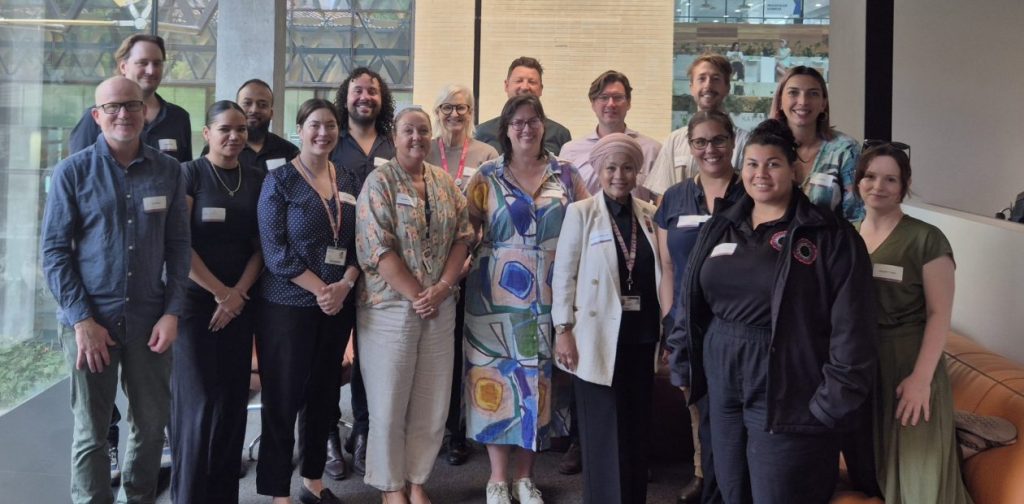
Presented last night at the ACSES Policy Symposium 2026 in Brisbane, the Awards celebrate the outstanding individuals and teams transforming outcomes for students from underrepresented and disadvantaged backgrounds.
ACSES Executive Director Professor Shamit Saggar congratulated this year’s recipients, who he said were shaping a fairer and more inclusive higher education landscape throughout Australia and beyond.
“Whether through groundbreaking research, transformative partnerships, or visionary advocacy and leadership, their contributions to the sector are immense,” Professor Saggar said.
“Their innovative ideas and approaches are not just influencing policymakers—they are having a profound and lasting impact on students, particularly those who face barriers to university participation and success.”
Now in its second year, the 2026 Awards recognised five winning teams across four categories.
Evidence and Research-Based Approach Award
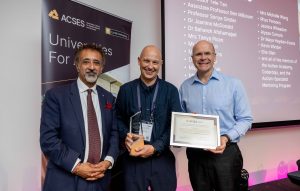
Professor Shamit Saggar, left, Associate Professor Ben Milbourn, and Distinguished Professor George Williams AO.
Program name: Tapping and strengthening the talents: Inclusive Education and Employment Pathways for Autistic Individuals – Autism Academy, Autism-Specialist Mentoring Program and Curtin Autism Research Group, Curtin University.
Key team members: Professor Tele Tan, Associate Professor Ben Milbourn, Professor Sonya Girdler, Dr Jasmine McDonald, Dr Bahareh Afsharnejad, Tanya Picen, Elaine Goh, Alex Jenkins, Dr Elinda Lee, Beth Cusak, Daniel Adams, Sandhya Subarmaniam, Michelle Wong, Rhys Parsons, Jessica Wheadon, Alyssa Carrara, Dr Maya Hayden-Evans, Kevin Winder, and all the mentors of the Autism Academy, Coderdojo, and the Autism-Specialist Mentoring Program.
Description: The Curtin University Autism Academy, Autism-Specialist Mentoring Program and Curtin Autism Research Group (CUAA-ASMP-CARG) form an integrated social innovation, strengths-based ecosystem that supports autistic people from secondary school to employment. The team helps neurodivergent individuals leverage their strengths and skills through accessible STEM pathways in areas such as cybersecurity, software testing, artificial intelligence, and digital innovation.
Since 2014, CUAA-ASMP-CARG has delivered a broad range of co-designed outreach, mentoring, internship, and community engagement initiatives. It has facilitated more than 150 internships with industry partners and over 100 high-value placements, with 55 trainees progressing into tertiary education. The team has supported more than 900 secondary students to participate in strengths-based technology education programs, with 48 participants attaining International Software Testing Qualifications Board (ISTQB) certification, and 72% of interns progressing into ongoing employment or scholarship support. CUAA-ASMP-CARG has received national and international recognition for advancing inclusive education, employment participation, and strengths-based approaches to neurodiversity.
Innovation and Originality Award
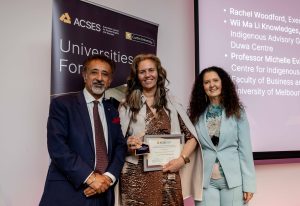
Professor Shamit Sagger, Rachel Woodford, and Professor Leanne Holt.
Program name: Dilin Duwa Centre for Indigenous Business Leadership.
Key team members: Professor Michelle Evans, Rachel Woodford.
Description: Led by Professor Michelle Evans (University of Melbourne), the Dilin Duwa Centre for Indigenous Business Leadership has been at the forefront of Indigenous business research and education since 2021. With the goal of building an economically powerful Indigenous Australia, the team’s extensive research informs government policy and has led to the creation of unique, immeasurably valuable intellectual property. The Centre’s education programs complement its research findings while generating connections to Country, regional communities, Indigenous leadership, and economic potential.
Dilin Duwa has created a unique and flourishing ecosystem that includes researchers, educators, students, policymakers, corporate partners, not-for-profit providers, and Indigenous agents of change. The benefits that flow across this continually transforming ecosystem are both relational and shared, creating new opportunities for all participants.
Innovation and Originality Award
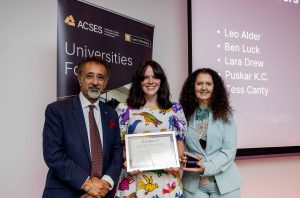
Professor Shamit Saggar, Therese Canty, and Professor Leanne Holt.
Program name: The Small Schools Program, University of Canberra.
Key team members: Leo Alder, Ben Luck, Lara Drew, Puskar K.C., and Therese Canty.
Description: The Aspire UC Small Schools Program stands out for its unique approach to careers education for primary school-aged students in rural and regional areas. It focuses on early childhood and primary school interventions through the delivery of ongoing, relational, and community-embedded careers learning that promotes higher education as an exciting and achievable goal to students from kindergarten to Year 6.
The Small Schools Program is grounded in evidence that shows early exposure, repeated contact, and authentic university experiences significantly increase the likelihood that young students from equity backgrounds will imagine themselves as future university learners. Recent evidence from a mixed-methods evaluation helped demonstrate the program’s impact, showing that it expanded students’ understanding of higher education, recognition of university as a pathway to desired careers, and sense of connection to the Aspire UC team.
Collaboration and Stakeholder Engagement Award
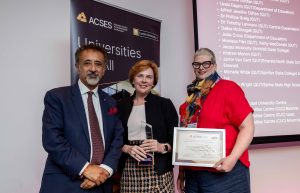
Professor Shamit Saggar, Associate Professor Jennifer Clifton, and Amber Elliott.
Program name: Employing Queensland: Innovative Pathways to Teaching (EQuIPT), Queensland University of Technology.
Key team members: Associate Professor Jennifer Clifton, Dr Danielle Gordan, Linda Eagers, Dr Phillipa Greig, Dr Timothy Lehmann, Dallas McDougall, Jodie Cross, Monique Filet, Kathy MacDonald, Jacqui McAnulty, Andrew Menon, Jamie Van Gent, Michelle White, Michelle Wright.
Cassowary Coast University Centre, Country Universities Centre (CUC) Balonne, CUC Isaac, CUC Mount Isa.
Barkly Highway State School (SS), Cardwell SS, Clermont State High School (SHS), Clermont SS, Denison SS, Doomadgee SS, Emerald North SS, Emerald SHS, Goondi SS, Goondiwindi SHS, Happy Valley SS, Healy SS, Inglewood SS, Innisfail State College (SC), Mission Beach SS, Moranbah East SS, Moranbah SHS, Moranbah SS, Mt Isa Central SS, Mt Isa Special School, Sarina SHS, Spinifex SC, St George SHS, Sunset SS, Townview SS, Tully SHS, Tully SS.
Description: Employing Queensland: Innovative Pathways to Teaching (EQuIPT) is an employment-based teacher education initiative that addresses two linked challenges: access to higher education in regional and remote areas, and persistent teacher workforce shortages. EQuIPT brings together Queensland University of Technology (QUT), Regional University Study Hubs (RUSH), the Queensland Department of Education, schools, and local communities. Through its hub model, participants combine employment and study with local academic support, mentoring, wellbeing support, and opportunities to build connection and belonging. The program has two streams: Grow Your Own, which supports local participants to begin a teaching degree while remaining in their community, and Send Our Best, which supports QUT-based pre-service teachers to relocate to hard-to-staff schools while completing their studies.
Since commencing in 2025, EQuIPT has supported 78 participants including many who are first-in-family to attend university, career changers, First Nations people, carers, and people living with disability. EQuIPT offers a transferable, evidence-informed model for increasing higher education participation while building sustainable local teacher workforces.
Impact and Effectiveness Award
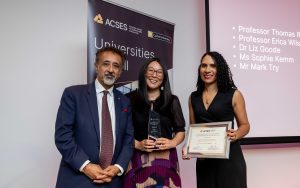
Professor Shamit Saggar, Dr Liz Goode, and Dr Cassy King.
Program name: Transforming Student Outcomes through the Southern Cross Model (SCM), Southern Cross University.
Key team members: Professor Thomas Roche, Professor Erica Wilson, Dr Liz Goode, Sophie Kemm, Mark Try.
Description: Developed at Southern Cross University (SCU), the Southern Cross Model (SCM) is a transformative, equity-focused curriculum reform that embeds inclusive, active, and manageable learning into university education. Across SCU, the SCM has replaced semesters, lectures, and exams with focused six-week terms, one- or two-unit enrolment loads, blended and active learning, and authentic assessment.
The SCM has embedded equity into curricula, systems, and policy at SCU, where 67% of domestic students identify with one or more equity groups. This whole-of-institution curriculum redesign has delivered sustained improvements in student outcomes. Overall success rates have risen by more than 15 percentage points to 91%, while commencing attrition has fallen by over 10 percentage points to 19%. Success has increased across all equity groups and study contexts, including for First Nations students, students with disability, students from low socio-economic status backgrounds, and online, part-time, and enabling students. The SCM provides a scalable, internationally recognised curriculum model for reshaping learning around diverse students’ lives, transforming their success, satisfaction, and retention.