Event information
Online via Zoom
The Australian Centre for Student Equity and Success (ACSES) is committed to developing research capacity in Australian higher education equity, especially through its support of the next generation of equity researchers.
This includes engaging, collaborating with, and funding students to conduct research on Australian higher education equity issues. The ACSES Higher Degree by Research (HDR) Stipend Scheme provides supplementary funding to higher degree by research students enrolled in an Australian university (Table A and Table B providers) to undertake a research project relating to Australian higher education student equity that leads to the publication of a journal article. The scheme is intended to encourage the translation of research to practice, evaluation, and policy in student equity.
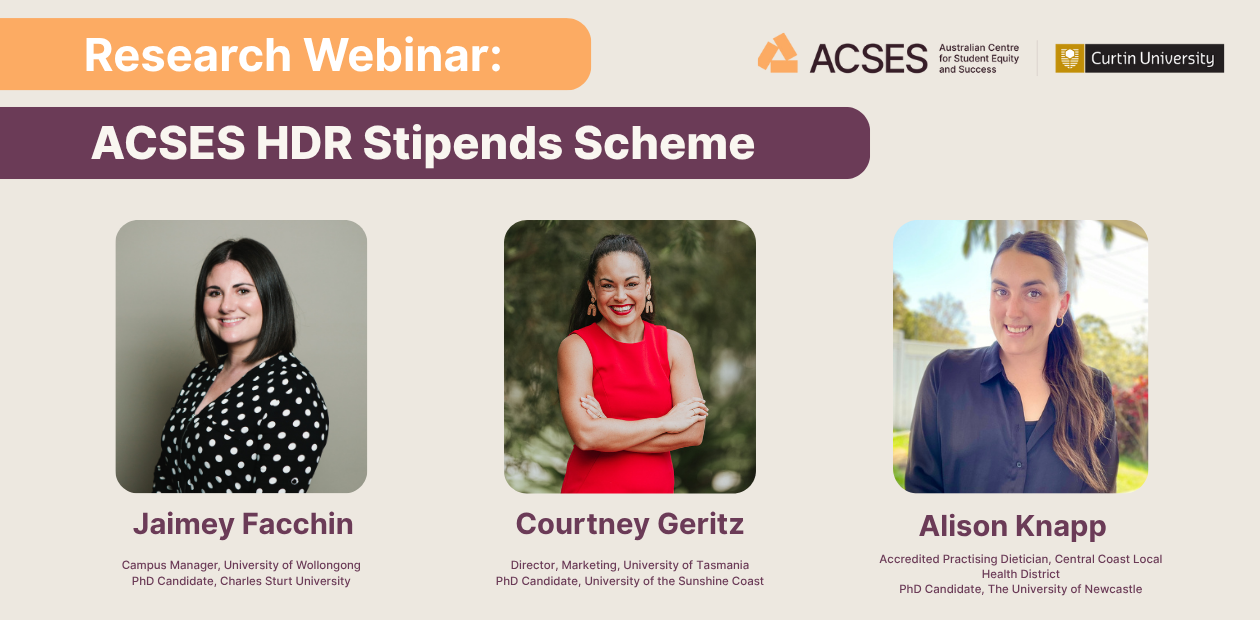
ACSES is pleased to launch this webinar, which will feature presentations from three recipients from the inaugural 2024-25 Round of the HDR Stipend Scheme.
About the speakers:
Jaimey Facchin
Project: The Role of Parents in the University Experiences of First in Family Students: A Systematic Review
Jaimey is the Manager of the University of Wollongong Eurobodalla campus, bringing over 14 years of diverse experience in the higher education sector. Her areas of expertise include Widening Participation, Outreach, Student Equity, Regional Education, and University Leadership. Jaimey is currently undertaking a PhD focused on the role of parents in the higher education journeys of First in Family students, under the supervision of Professor Sarah O’Shea and Dr Nicole Crawford at Charles Sturt University. She holds a Master of Education (Higher Education) with distinction, a Bachelor of Arts (Honours) in Sociology, and a Bachelor of Arts with Distinction in Community, Culture and Environment, and Sociology.
Her project shares findings from a systematic review exploring how parents support First in Family (FiF) and First-Generation Students (FGS) in higher education. While research increasingly highlights the experiences of FiF/FGS students, the role of parents is often overlooked. Drawing on 93 studies, this review identifies three thematic patterns: parental roles as background influences, student narratives of support, and studies that directly engage parents. Across these themes, parents emerge as active contributors to their children’s educational journeys, offering emotional encouragement, aspirational guidance, and practical support. Their involvement reflects diverse forms of knowledge, care, and commitment, even when navigating unfamiliar systems. The review highlights the need for more inclusive research that recognises family strengths and values parental perspectives, especially in an Australian context.
Courtney Geritz
Project: Turning lemons into lemonade: How first-year, first-time regional and remote university students turn disappointment into satisfaction.
Courtney is a proud Aboriginal woman living and working on Palawa Country. She is an accomplished marketing leader and PhD Research Candidate at the University of the Sunshine Coast. With over two decades of experience in higher education and the tertiary sector, Courtney has built a career around her passion for communicating the value of education and creating rewarding student experiences.
Having grown up in a regional town without access to a local university, Courtney is deeply committed to improving equity and opportunity for regional and remote students. Alongside her research, she teaches first-year marketing subjects within the School of Business, where she supports students at the beginning of their university journey, helping them build confidence and a sense of belonging.
Her research, under the supervision of Professor Maria Raciti, Dr Aaron Tham, and Dr Da Eul Jeong, explores how student expectations and lived experiences shape satisfaction and engagement in higher education, contributing valuable insights to both marketing practice and educational equity.
Her project advances the understanding of complex service ecosystems, such as higher education, by addressing key gaps in how consumers form gist-based expectations, interpret mismatches between expectations and experiences, and self-manage dissonance to improve satisfaction. The findings aim to extend theory and inform equitable practice by offering tools to shape authentic expectations and support student consumers in navigating cognitive dissonance effectively.
Grounded in Fuzzy Trace Theory (Reyna, 1991) and Cognitive Dissonance Theory (Festinger, 1957), the study draws on a large-scale national survey of first-year, first-time regional and remote students (n = 405). Using structural equation modelling, the research examines how gist-induced expectations and dissonance self-management influence satisfaction.
The results will provide actionable insights for policymakers and practitioners seeking to improve the equity and inclusiveness of the student experience in complex, high-stakes service environments such as higher education.
Alison Knapp
Project: Social determinants of depression and anxiety symptoms in undergraduate university students in Australia; Findings from The UNIversity student’s LIFEstyle and Mental Health Study (UNILIFE-M)
Alison Knapp is a PhD candidate from the University of Newcastle and a member of the HMRI Food and Nutrition Research Program. Her doctoral research focuses on exploring social determinants of health behaviours including diet, physical activity, sedentary behaviour, sleep, smoking, alcohol and drug use, and mental health among university students. Under the supervision of Associate Professor Melinda Hutchesson, Professor Tracy Burrows (University of Newcastle), and Dr Sjaan Gomersall (University of Queensland), Alison’s research aims to better understand how social and environmental factors influence wellbeing during the transition to adulthood. With a background in clinical and public health nutrition, her work contributes to identifying at-risk student population groups and informing evidence-based interventions to promote both physical and mental health in tertiary education settings.
Her project explores how entering university marks a pivotal stage in personal development, offering opportunities for growth and independence but is often accompanied by mental health challenges. Understanding the social determinants of mental health is essential for guiding effective interventions and policy, yet knowledge gaps remain for this population. The UNIversity student’s LIFEstyle and Mental Health Study (UNILIFE-M) is an international cohort study conducted across 84 universities in 27 countries. This secondary cross-sectional analysis draws on 2023/24 baseline Australian data from 974 first-year students (aged 18–35 years) at six universities. Her team explored associations between social determinants (sex, gender, sexual orientation, employment, living situation, ethnicity, and First Nations status) and mental health symptoms. Sixty percent screened positive for both depression and anxiety, 17% for anxiety only, and 9% for depression only. Elevated symptom severity was more likely among females, First Nations, and sexually and ethnically diverse students. Findings can inform universities and policymakers in implementing targeted mental health prevention and treatment initiatives.
Webinar recording
A recording of the webinar can be viewed here.